 DSTechnoverse company
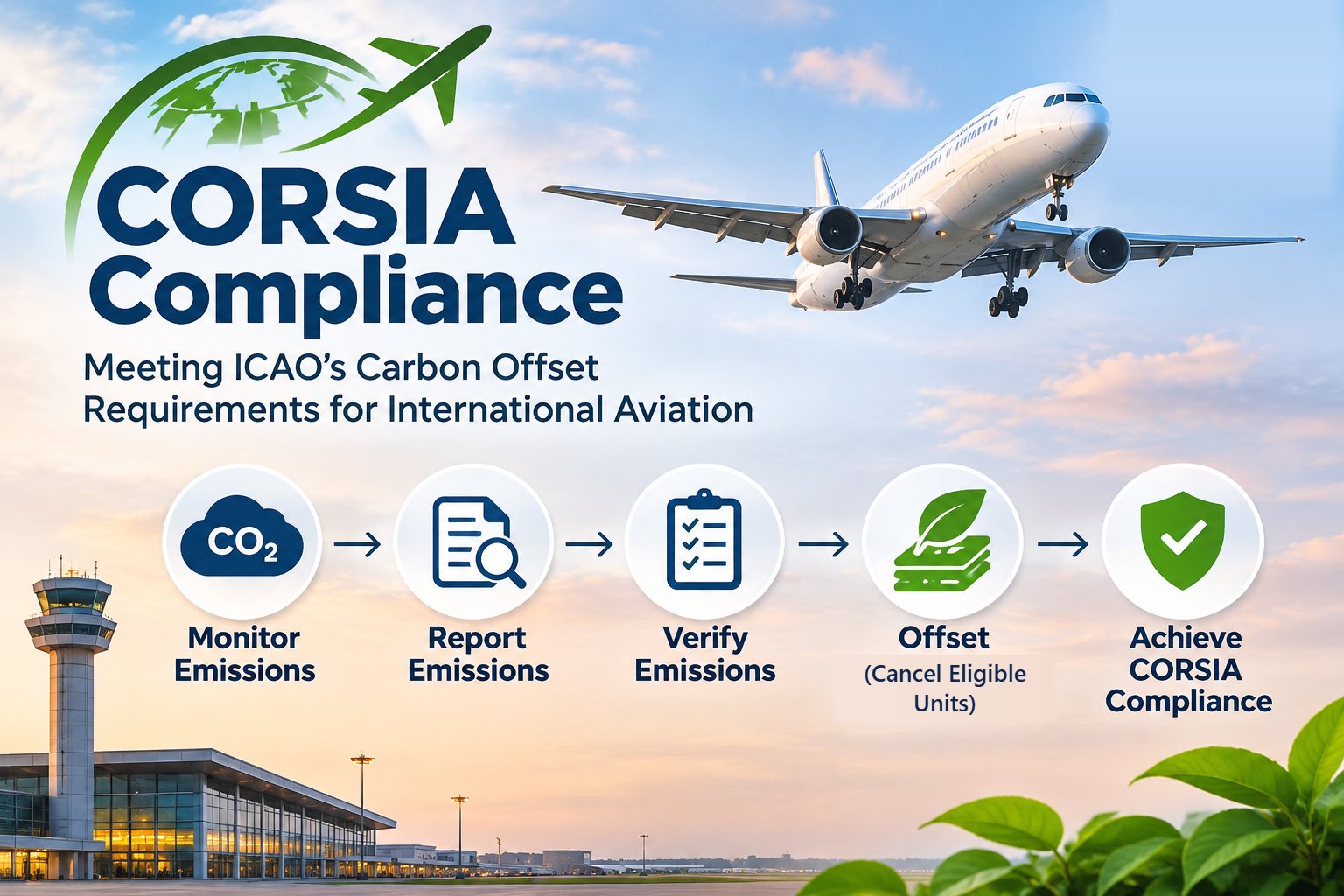
What is CORSIA compliance? CORSIA compliance means an airline has met every obligation that applies to it under ICAO's Carbon Offsetting and Reduction Scheme for International Aviation. In practice, that means monitoring fuel use under an approved plan, submitting a verified emissions report every year and, for routes between participating States, cancelling enough CORSIA Eligible Emissions Units to cover its offsetting obligation for each compliance period, then reporting the cancellation. For more on those units, see our CORSIA Carbon Credits resources.
This guide looks at compliance as a process that runs across a three-year compliance period: who is responsible for what, how yearly reports turn into an offsetting obligation, and how airlines can manage it with fewer surprises. It reflects ICAO rules and guidance available in November 2026. For a requirement-by-requirement breakdown, see our guide to CORSIA requirements.
What Is CORSIA Compliance?
CORSIA, the Carbon Offsetting and Reduction Scheme for International Aviation, was adopted by the International Civil Aviation Organization (ICAO) in 2016. ICAO set the framework in Annex 16, Volume IV to the Chicago Convention. Each Member State then puts it into national law and oversees the airlines attributed to it.
CORSIA compliance has two layers:
- MRV compliance: monitoring, reporting and verifying CO₂ from international flights every year.
- Offsetting compliance: cancelling eligible units to cover the offsetting obligation for each compliance period.
The framework addresses CO₂ from international flights by requiring airlines to offset growth above a baseline of 85% of 2019 emissions on covered routes. It does not require airlines to offset all their emissions, and it does not cover domestic flights.
Why Is CORSIA Compliance Important?
- Growing emissions. International air traffic keeps rising, and aviation is commonly estimated to produce around 2–3% of global CO₂ emissions.
- Global climate action. CORSIA is the only global market-based measure for international aviation, reaffirmed by the 42nd ICAO Assembly in 2025.
- Transparency and accountability. Verified annual data makes airlines' international emissions visible and comparable.
- Regulatory cooperation. One ICAO framework avoids conflicting national rules for flights that cross borders.
- Carbon market role. Compliance creates demand for high-integrity, authorised carbon credits, and for the projects behind them.
Non-compliance also carries legal and reputational risk under each State's implementing rules.
Who Needs to Comply With CORSIA?
Aeroplane operators
An operator must comply with MRV requirements if it:
- operates international flights between different States
- emits more than 10,000 tonnes of CO₂ a year from those flights
- uses aeroplanes with a maximum take-off mass above 5,700 kg
Participating States
States administer CORSIA for the operators attributed to them, usually by air operator certificate. They approve monitoring plans, review reports, calculate offsetting requirements and report to ICAO. In India, this is the Directorate General of Civil Aviation (DGCA).
Route-based coverage
Offsetting applies only to flights between two participating States. A route touching a non-participating State is monitored and reported but not offset.
Exemptions
- domestic flights
- humanitarian, medical and firefighting flights
- operators below the 10,000-tonne threshold
- new entrants, for their first three years or until they reach 0.1% of total international revenue tonne kilometres
How operators check their scope
- Total the CO₂ from international flights with aeroplanes above 5,700 kg.
- Compare it with the 10,000-tonne threshold.
- List each route's State pair.
- Check ICAO's annual list of State pairs subject to offsetting.
CORSIA does not automatically apply to every airline or every flight.
What Are the Main CORSIA Compliance Requirements?
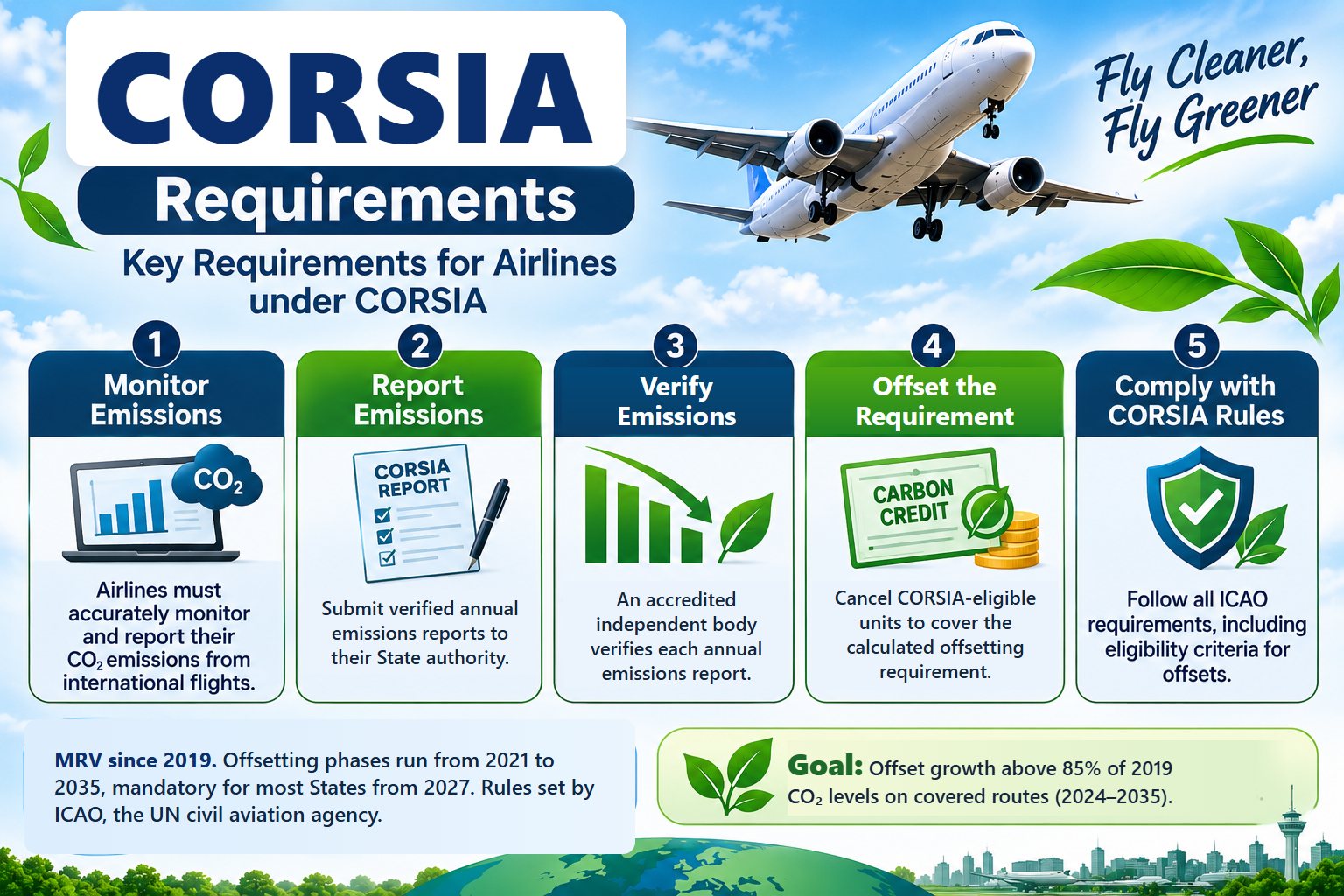
1. Emissions Monitoring
- Record fuel consumption on every international flight.
- Maintain an approved Emissions Monitoring Plan.
- Use an approved monitoring method, or ICAO's CERT tool where allowed.
- Keep accurate emissions data.
2. Emissions Reporting
- Prepare an annual CO₂ Emissions Report by State pair.
- Submit it to the national authority.
- Meet the reporting deadline, generally 30 April of the following year.
- Keep supporting records.
3. Independent Verification
- Have each report verified by an accredited verification body.
- Allow verifiers to review calculations and data sources.
- Correct discrepancies before submission.
- Maintain data quality over time.
4. Carbon Offsetting
- Understand the offsetting obligation set by the State.
- Identify eligible emissions units.
- Purchase and transfer units into the airline's registry account or arrange cancellation on its behalf.
- Cancel the units and complete compliance documentation.
How Does the CORSIA Compliance Process Work?
- Determine applicability against the thresholds.
- Identify covered routes using ICAO's State pair list for each year.
- Prepare an Emissions Monitoring Plan and have it approved.
- Monitor fuel consumption on every international flight.
- Calculate annual CO₂ emissions using ICAO's conversion factors.
- Submit emissions reports to the national authority.
- Obtain independent verification.
- Determine offsetting obligations from the State's calculation for each year.
- Acquire eligible units for the total compliance period obligation.
- Cancel units and complete documentation, including an Emissions Unit Cancellation Report.
Steps 1 to 7 are reporting obligations. They apply every year to every covered operator. Steps 8 to 10 are offsetting obligations, settled once per compliance period, and only for emissions on covered routes.
CORSIA Emissions Monitoring and Reporting Compliance
Who does what inside an airline
Compliance works best when responsibilities are clear:
- Fuel and operations data teams collect fuel records from flight systems, fuel slips and technical logs.
- Sustainability or environment teams run the monitoring plan, calculate CO₂ and prepare reports.
- Finance and procurement teams forecast and buy eligible units.
- Legal or compliance teams track national rules and deadlines.
- Senior management signs off reports and budgets.
Monitoring methods and calculation
ICAO's rules set out approved fuel use monitoring methods, such as block-off/block-on and fuel uplift methods. CO₂ is calculated from fuel burned using ICAO's factors, such as 3.16 tonnes of CO₂ per tonne of Jet-A or Jet-A1.
Data management and record retention
- reconcile fuel data from different systems
- document any estimates used for missing data
- keep monitoring plans, reports and verification records for the retention period required by the State and ICAO rules
- track changes in fleet or operations that require an updated monitoring plan
Responsibilities of authorities
National authorities approve monitoring plans, review verified reports, carry out checks and send aggregated data to ICAO.
CORSIA Verification and Audit Requirements
Purpose
Verification confirms that reported emissions are complete and accurate, because offsetting obligations depend on them.
Verification bodies
- must be accredited under international greenhouse gas verification standards
- must be independent of the airline
- check the report against the approved monitoring plan and ICAO's rules
Procedures and data checks
Verifiers typically review:
- the completeness of the flight list
- fuel data sources and controls
- the monitoring method applied
- calculations and State-pair allocation
- how data gaps were handled
Errors and discrepancies
Material misstatements must be corrected before the report is accepted. Non-material issues may be recorded as recommendations.
Reports and oversight
The verifier issues a verification report, which accompanies the emissions report. The national authority then reviews both. Cancellation reports are also verified before submission.
CORSIA Carbon Credit and Offsetting Compliance
Eligible Emissions Units
CORSIA Eligible Emissions Units (EEUs) are carbon credits that count towards offsetting obligations. ICAO's Technical Advisory Body assesses carbon-crediting programmes, and the ICAO Council approves them for specific compliance periods.
Programme approval versus unit eligibility
- Programme approval means a programme may supply eligible units.
- Unit eligibility means an individual credit meets every condition for the compliance period.
Both must be satisfied.
First-phase unit conditions
For 2024–2026, eligible units generally need:
- activities that started on or after 1 January 2016
- vintages from 2021 to 2026
- host-country authorisation, through a Letter of Authorisation
- a corresponding adjustment under Article 6 of the Paris Agreement, or an approved compensation arrangement where the programme allows it
- a CORSIA label in the programme's registry
Registry transfer and cancellation
Units are transferred into the airline's registry account, or cancelled on its behalf, then cancelled with a record of the airline and compliance period. The airline submits a verified Emissions Unit Cancellation Report to its State.
Ordinary voluntary carbon credits are not automatically accepted. Our guide to CORSIA eligible emissions units lists the approved programmes and their conditions. Our guide to CORSIA carbon credits insurance explains compensation arrangements for units awaiting corresponding adjustments.
CORSIA Compliance Phases
Pilot Phase (2021–2023)
- Participation: voluntary for States.
- Main features: a baseline of 2019 emissions, and eligible units with vintages from 2016 to 2020.
First Phase (2024–2026)
- Participation: still voluntary, with more than 100 States taking part.
- Monitoring and offsetting: annual MRV, a baseline of 85% of 2019 emissions, and stricter unit conditions including host-country authorisation.
- Deadline: units for this period must be cancelled by January 2028.
Second Phase (2027–2035)
- Participation: mandatory for States with significant shares of international aviation.
- Exemptions: least developed countries, small island developing states and landlocked developing countries, unless they volunteer, and States with very small shares of activity.
- Compliance periods: three-year periods, starting with 2027–2029, with unit conditions set by ICAO for each period.
The pilot phase is complete. First-phase obligations are being settled now, and second-phase rules continue to be refined through ICAO decisions.
How Do Airlines Calculate CORSIA Compliance Obligations?
The components
- Operator emissions on covered routes, from verified reports.
- Baseline: 85% of 2019 international aviation CO₂ emissions.
- Growth factor: published by ICAO for each year. Under current rules, it is fully sectoral until 2032, then 85% sectoral and 15% individual from 2033 to 2035.
- Eligible fuel reductions, which are subtracted.
Yearly offsetting requirement = Covered emissions × Growth factor − Eligible fuel reductions
The national authority calculates the requirement each year. The airline settles the total for the three-year compliance period.
How yearly reports become a period obligation (hypothetical example)
The growth factors below are assumptions for illustration, not ICAO values.
- 2024: covered emissions of 500,000 tonnes × 0.02 = 10,000 tonnes
- 2025: covered emissions of 520,000 tonnes × 0.03 = 15,600 tonnes
- 2026: covered emissions of 540,000 tonnes × 0.04 = 21,600 tonnes, minus 600 tonnes of eligible fuel reductions = 21,000 tonnes
Total for 2024–2026: 46,600 eligible units, to be cancelled by the first-phase deadline.
Reported emissions versus offsetting obligations
In this example, the airline reported over 1.5 million tonnes of covered emissions across three years, plus any emissions on routes not covered. Its offsetting obligation is about 3% of the covered total. Not every reported tonne creates an offsetting obligation.
Factors and allocation rules can change between periods, so airlines must use the values ICAO publishes for each year. Our step-by-step guide on how CORSIA works explains the calculation inputs in more detail.
What Happens If an Airline Fails to Meet CORSIA Compliance Requirements?
- Reporting deficiencies: late or incomplete reports can lead the authority to request corrections, or to estimate emissions conservatively.
- Verification issues: reports with material misstatements are not accepted until corrected.
- Corrective actions: authorities can require updated monitoring plans, better data controls or resubmission.
- Regulatory oversight: national authorities, not ICAO, enforce CORSIA against their airlines.
- Enforcement mechanisms and consequences: these depend on each State's national implementing rules, and can differ widely between countries.
There is no single, uniform CORSIA penalty. Airlines should check the enforcement provisions in their own State's legislation.
Common CORSIA Compliance Challenges
- Complex international rules, with ICAO, national and programme-level requirements
- Data collection and accuracy, especially across mixed fleets and outsourced operations
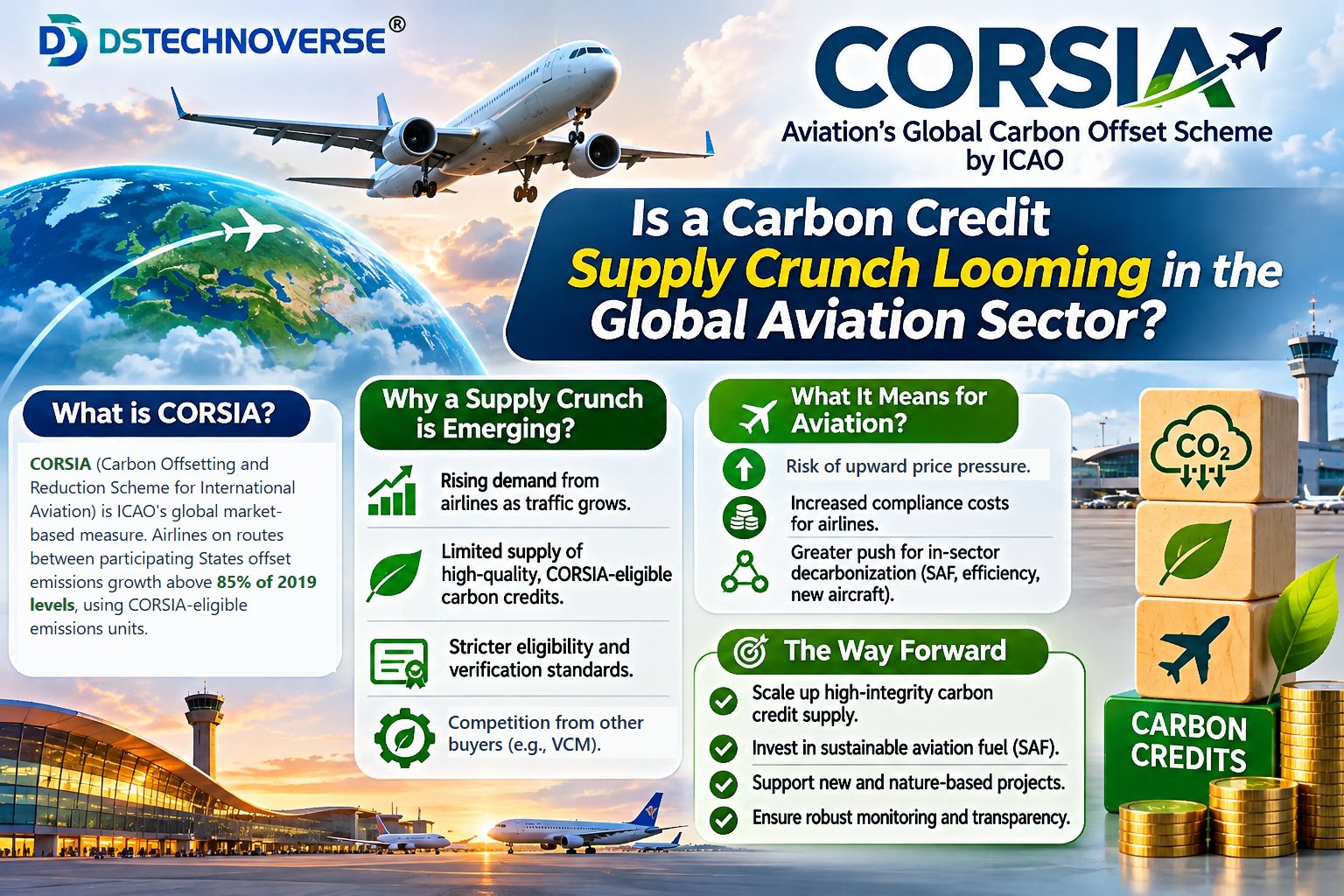
- Availability of eligible units: IATA estimated first-phase demand at 200–250 million units, against about 72 million covered by compatible host-country authorisations in August 2026
- Carbon credit quality and integrity
- Registry and documentation requirements, such as labels, serial numbers and cancellation records
- Regulatory updates between phases and compliance periods
- Compliance costs: first-phase units were assessed at about US$19 in January 2026 and US$13 in November 2026 (Fastmarkets)
How Can Airlines Prepare for Future CORSIA Compliance?
- Establish internal compliance procedures, with clear owners for MRV, procurement and reporting.
- Improve emissions data management, automating fuel data collection where possible.
- Work with qualified verification bodies, engaging them early in each reporting cycle.
- Monitor ICAO updates, including the State pair list, growth factors and eligible units document.
- Forecast obligations for each year of the compliance period, not just at the end.
- Conduct carbon credit due diligence on every unit: programme, vintage, authorisation and label.
- Diversify procurement, combining spot purchases and forward agreements.
- Maintain proper records for every step, from fuel data to cancellation.
- Evaluate complementary measures, such as sustainable aviation fuel and efficiency improvements, which reduce obligations.
Our CORSIA compliance calendar sets out the key annual dates.
Future of CORSIA Compliance
Confirmed regulatory developments:
- The second phase starts on 1 January 2027, with mandatory participation for most States with significant international aviation.
- ICAO has approved emissions unit programmes for the 2027–2029 compliance period and continues to assess others.
- ICAO members adopted a long-term aspirational goal of net-zero carbon emissions from international aviation by 2050.
Expectations, not certainties:
- more routes covered as large aviation markets, such as India, start offsetting in 2027
- updated unit criteria for later periods
- wider Article 6 authorisation by host countries, which could ease supply
- greater use of sustainable aviation fuel, reducing offsetting obligations
- more transparent registries and authorisation records
Frequently Asked Questions
What is CORSIA compliance?
Meeting all CORSIA obligations that apply to an airline: monitoring, reporting and verifying international CO₂ emissions each year, and cancelling eligible units to cover any offsetting obligation for each compliance period.
Who needs to comply with CORSIA?
Aeroplane operators with more than 10,000 tonnes of CO₂ a year from international flights, using aeroplanes above 5,700 kg. Offsetting applies only to their flights between participating States.
What are the main CORSIA compliance requirements?
Emissions monitoring under an approved plan, annual emissions reporting, independent verification and, where routes are covered, carbon offsetting with eligible emissions units.
How do airlines meet CORSIA compliance obligations?
By submitting verified emissions reports each year, then acquiring and cancelling enough eligible units to cover their total obligation for the compliance period, and submitting a cancellation report.
What are CORSIA emissions monitoring requirements?
Recording fuel use on every international flight with an approved method set out in an Emissions Monitoring Plan, and converting fuel to CO₂ using ICAO's conversion factors.
Does CORSIA require airlines to purchase carbon credits?
Only where they have an offsetting obligation on covered routes. They must then acquire and cancel CORSIA eligible emissions units, not ordinary voluntary credits.
What are eligible emissions units under CORSIA?
Carbon credits from ICAO-approved programmes that meet the compliance period's conditions, including vintage, host-country authorisation and a CORSIA label in the registry.
What happens if an airline does not comply with CORSIA?
Its national authority can require corrections and apply enforcement measures under national law. Consequences differ from country to country.
What are the three CORSIA compliance phases?
The pilot phase (2021–2023) and first phase (2024–2026), with voluntary State participation, and the second phase (2027–2035), when participation becomes mandatory for most large aviation States.
How can airlines prepare for CORSIA compliance?
Assign clear internal responsibilities, improve fuel data systems, engage verifiers early, track ICAO updates, forecast obligations each year and carry out due diligence on every unit.
Conclusion
CORSIA compliance is a cycle that runs every year and settles every three years. Each year, covered airlines monitor fuel, report emissions and have them verified. At the end of each compliance period, they cancel enough CORSIA Eligible Emissions Units to cover the obligation their State has calculated for routes between participating States, and they report the cancellation.
Most reported emissions never become an offsetting obligation, but the ones that do must be settled with units that meet ICAO's exact conditions. Airlines that organise their data, forecast obligations early and check every unit carefully will be best prepared as the scheme expands in 2027. Always rely on the latest official ICAO and national requirements.
To learn more about CORSIA eligible units and airline compliance, explore the resources at CORSIA Carbon Credit.
Sources
- ICAO – CORSIA Eligible Emissions Units
- ICAO – CORSIA Eligible Emissions Units document (April 2026)
- ICAO – CORSIA States for Chapter 3 State Pairs
- EASA – ICAO Carbon Offsetting and Reduction Scheme for International Aviation (CORSIA)
- IATA – CORSIA fact sheet
- IATA – ICAO 42nd Assembly: key environment-related outcomes
- UNFCCC – Article 6 of the Paris Agreement
- IATA / EuropaWire – ICAO joins alliance to address CORSIA supply shortfall (13 October 2026)
- Fastmarkets – CORSIA prices tick higher on increased buyer inquiries (November 2026)