 DSTechnoverse company
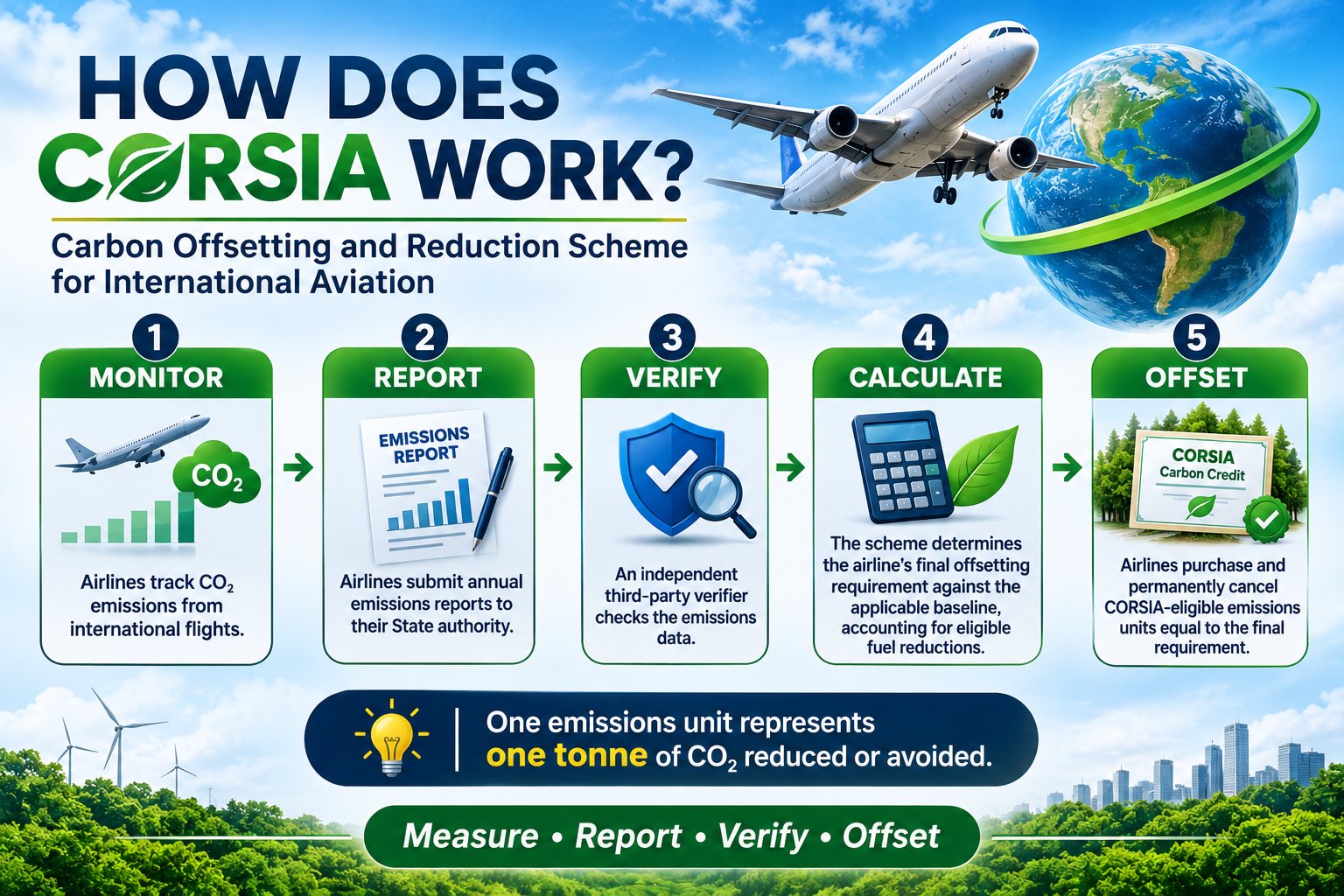
How does CORSIA work? Airlines that fly international routes and emit more than 10,000 tonnes of CO₂ a year monitor their fuel use, report their emissions each year to their national authority and have the reports independently verified. For flights between States that both take part in offsetting, the authority then calculates an offsetting requirement based on growth above a baseline of 85% of 2019 emissions. The airline meets it by cancelling CORSIA Eligible Emissions Units, approved carbon credits, and reporting the cancellation. For more on the credits involved, see our CORSIA Carbon Credits resources.
This guide walks through each step of the mechanism, explains who is covered, how the numbers are calculated and how airlines buy and use eligible units. It reflects ICAO rules and market data available in November 2026.
What Is CORSIA?
CORSIA stands for the Carbon Offsetting and Reduction Scheme for International Aviation. It is a global market-based measure adopted by the International Civil Aviation Organization (ICAO), the UN agency for civil aviation, at its 39th Assembly in 2016. Its rules are set out in Annex 16, Volume IV to the Chicago Convention.
CORSIA's objective is to address the growth in CO₂ emissions from international aviation. It does not require airlines to offset all their emissions. Instead, it requires them to compensate for a share of emissions growth above a baseline.
Within the aviation industry's climate strategy, CORSIA is one of four groups of measures promoted by ICAO:
- aircraft technology, such as more efficient engines
- operational improvements, such as better routing
- sustainable aviation fuels, which also reduce CORSIA obligations
- market-based measures, which is where CORSIA sits
Our overview of the CORSIA Carbon Offsetting and Reduction Scheme covers the scheme's background in more detail. This guide focuses on how it works in practice.
Why Was CORSIA Introduced?
- Growth in international air travel. Demand for international flights has grown for decades and is expected to keep growing.
- Aviation emissions. Aviation is commonly estimated to account for around 2–3% of global CO₂ emissions.
- A gap in national targets. Under the Paris Agreement, countries count emissions within their borders. Emissions from flights between countries do not fit neatly into any one country's target.
- The need for global cooperation. A single scheme agreed through ICAO avoids a patchwork of national taxes and schemes on the same routes.
- A bridge to decarbonisation. New aircraft and cleaner fuels take time to scale. CORSIA addresses emissions growth in the meantime.
In 2022, ICAO members also adopted a long-term aspirational goal of net-zero carbon emissions from international aviation by 2050. CORSIA supports that path, but most of the long-term reductions are expected to come from fuels, technology and operations.
How Does CORSIA Work Step by Step?
Here is how CORSIA works in practice, from scope to compliance:
- Check scope. The airline confirms whether it is covered: international flights, emissions above 10,000 tonnes of CO₂ a year, and aeroplanes above 5,700 kg maximum take-off mass.
- Monitor fuel and emissions. It follows an approved Emissions Monitoring Plan, recording fuel use on every international flight.
- Report. After each year, it compiles an Emissions Report, broken down by State pair.
- Verify. An accredited verification body checks the report before it is submitted to the national authority.
- Set offsetting requirements. The national authority identifies emissions on routes between participating States and applies ICAO's growth factors.
- Calculate the final obligation. The requirement is reduced by any claims for CORSIA eligible fuels.
- Acquire eligible units. The airline buys CORSIA Eligible Emissions Units through suppliers, brokers or exchanges.
- Cancel the units. Units are cancelled in the programme registry, specifying CORSIA, the airline and the compliance period.
- Report compliance. The airline submits an Emissions Unit Cancellation Report, which the national authority checks and reports to ICAO.
Steps 1 to 4 are MRV obligations. They apply to every covered airline, whether or not any of its routes require offsetting. Steps 5 to 9 are offsetting obligations, which apply only to emissions on covered routes.
Who Needs to Follow CORSIA?
Covered operators
CORSIA compliance starts with these thresholds:
- aeroplane operators with more than 10,000 tonnes of CO₂ a year from international flights
- aeroplanes with a maximum take-off mass above 5,700 kg
Exempt flights and operators
- domestic flights
- humanitarian, medical and firefighting flights
- operators below the emissions threshold
- new entrants, which are exempt from offsetting for their first three years or until they reach 0.1% of total international revenue tonne kilometres
Participating States and routes
Offsetting depends on route pairs, not on the airline's nationality:
- A flight between two participating States counts towards offsetting.
- A flight involving at least one non-participating State is monitored and reported but not offset.
- This applies to all airlines flying the route, wherever they are based.
Example (illustrative): an airline based in State A flies to States B and C. If A and B participate but C does not, emissions on the A–B route count towards offsetting. Emissions on the A–C route are monitored and reported only. Our guide on whether your airline is covered by CORSIA walks through this test.
What Are the Three Phases of CORSIA?
Pilot Phase (2021–2023)
- Participation: voluntary for States.
- Baseline: 2019 emissions, after ICAO decided in 2020 to exclude the pandemic year.
- Eligible units: generally from activities starting from 2016, with vintages from 2016 to 2020.
First Phase (2024–2026)
- Participation: still voluntary. More than 100 States chose to take part.
- Baseline: 85% of 2019 emissions, set by the 41st ICAO Assembly in 2022.
- Eligible units: vintages from 2021 to 2026, with host-country authorisation and a corresponding adjustment.
- Deadline: airlines must cancel units for the 2024–2026 period by January 2028.
Second Phase (2027–2035)
- Participation: mandatory for States with significant shares of international aviation activity.
- Exemptions: least developed countries, small island developing states and landlocked developing countries, unless they volunteer, and States with very small shares of activity.
- Compliance periods: three-year periods, starting with 2027–2029.
- Effect: large aviation markets that did not volunteer earlier, such as India, will face offsetting requirements from 2027.
The pilot phase is now complete. The first phase is under way, and its obligations are being settled. Requirements for the second phase continue to be refined through ICAO decisions.
How Does CORSIA Measure Aviation Emissions?
The basis: fuel burned
CORSIA emissions monitoring is based on fuel consumption. Burning jet fuel releases CO₂ in a fixed ratio, so measuring fuel accurately gives an accurate emissions figure.
Emissions Monitoring Plans
Each airline's national authority approves an Emissions Monitoring Plan setting out:
- the fleet and types of operations
- the fuel use monitoring method used
- how data gaps and errors are handled
ICAO's rules allow several approved fuel use monitoring methods, such as measuring fuel in the tanks at block-off and block-on, or using fuel uplift records. Smaller emitters may use ICAO's CORSIA CO₂ Estimation and Reporting Tool (CERT), within set thresholds.
Illustrative calculation
CO₂ emissions = Fuel used (tonnes) × Fuel conversion factor
ICAO's conversion factor for Jet-A and Jet-A1 fuel is 3.16 tonnes of CO₂ per tonne of fuel. If an aircraft burns 40 tonnes of Jet-A1 on a long-haul flight, its CO₂ emissions are about 40 × 3.16 = 126.4 tonnes (illustrative figures).
This is a simplified illustration. Official reporting follows the approved monitoring method and ICAO's detailed rules.
Monitoring, reporting and verification (MRV)
- Monitoring: flight-by-flight fuel data.
- Reporting: an annual Emissions Report, generally due to the national authority by 30 April of the following year.
- Verification: by a verification body accredited to international greenhouse gas verification standards.
- State review: the authority checks the verified report and sends data to ICAO.
How Are CORSIA Offsetting Requirements Calculated?
CORSIA offsetting requirements are calculated by the airline's national authority, using verified emissions and factors published by ICAO.
The inputs
- Covered emissions: the airline's emissions on routes between participating States in a given year.
- Baseline: for 2024 to 2035, 85% of 2019 international aviation CO₂ emissions.
- Sectoral growth factor: the growth of the whole sector's covered emissions above the baseline, published by ICAO each year.
- Individual growth factor: the growth of the airline's own emissions.
The allocation rule
Under current rules:
- 2024 to 2032: the requirement is based 100% on the sectoral growth factor.
- 2033 to 2035: it is based 85% on the sectoral factor and 15% on the individual factor.
The structure of the calculation
Offsetting requirement = Covered emissions × Growth factor − Emissions reductions from CORSIA eligible fuels
Illustrative example (hypothetical values):
- Covered emissions in a year: 90,000 tonnes
- Assumed sectoral growth factor: 0.07
- Gross requirement: 90,000 × 0.07 = 6,300 tonnes
- Eligible fuel reductions claimed: 300 tonnes
- Final requirement: 6,000 tonnes, so 6,000 eligible units to cancel
The growth factor here is an assumption for illustration, not an ICAO value.
Why monitoring and offsetting numbers differ
An airline's total reported emissions cover all its international flights. Its offsetting requirement applies only to covered routes, and only to a growth-based share. That is why reported emissions are usually many times larger than the number of units an airline must cancel.
The factors and allocation rules can change between compliance periods, so airlines must use the values ICAO publishes for each year. Our CORSIA compliance calendar lists the key annual dates.
What Are CORSIA Eligible Emissions Units?
CORSIA Eligible Emissions Units are carbon credits that airlines can cancel to meet their offsetting requirements. Each generally represents one tonne of CO₂ equivalent reduced or removed.
ICAO's role:
- The Technical Advisory Body (TAB) assesses carbon-crediting programmes against the Emissions Unit Eligibility Criteria.
- The ICAO Council approves programmes for specific compliance periods, often with conditions.
Unit conditions for the first phase generally include:
- activities starting on or after 1 January 2016
- vintages from 2021 to 2026
- host-country authorisation, with the host country applying a corresponding adjustment under Article 6 of the Paris Agreement
- a CORSIA label in the programme registry
Where the corresponding adjustment is not yet confirmed, some programmes accept approved insurance or compensation arrangements in its place.
Ordinary voluntary carbon credits are not automatically eligible. A credit can be valid for a company's voluntary claim and still fail CORSIA's conditions. Our guide to CORSIA eligible emissions units lists the approved programmes and conditions in detail.
How Do Airlines Purchase and Use CORSIA Carbon Credits?
Identify the obligation
The national authority's calculation gives the number of units needed for each year of the compliance period.
Select eligible units
Airlines check:
- the programme against ICAO's latest eligible units document
- the methodology and activity type
- the vintage and start date
- the Letter of Authorisation and corresponding adjustment status
- the registry record, including serial numbers and the CORSIA label
Purchase
Common channels include:
- project developers, through direct contracts
- traders and brokers
- exchanges and platforms that list CORSIA-eligible units
- forward or offtake agreements, securing future supply
ICAO does not operate a central marketplace. Prices vary: first-phase units were assessed at about US$19 in January 2026 and US$13 on 18 November 2026 (Fastmarkets).
Cancel and report
- Units are cancelled in the programme registry, stating that they are used for CORSIA, by which airline and for which compliance period.
- The airline submits an Emissions Unit Cancellation Report to its national authority.
- The authority reviews it and reports to ICAO.
Buying units does not complete compliance. Only cancelled and reported units count.
Benefits of CORSIA
- One global framework for international aviation emissions
- Consistent MRV data across airlines and countries since 2019
- Predictable rules that airlines can plan around
- An incentive for sustainable aviation fuel, which reduces offsetting requirements
- Climate finance for emission reduction and removal projects worldwide
- Integrity safeguards, through ICAO approval, vintage rules and host-country authorisation
Challenges of CORSIA
- Limited eligible supply. IATA estimated first-phase demand at 200–250 million units, against about 72 million covered by compatible host-country authorisations in August 2026.
- Price volatility as new supply is labelled.
- Complex due diligence for every unit.
- Changing participation as States join, which changes which routes are covered.
- Debate about ambition, because CORSIA offsets growth rather than total emissions.
- Slow scale-up of sustainable aviation fuel, which keeps reliance on offsets high for now.
Future of CORSIA
Confirmed:
- The second phase starts on 1 January 2027, with mandatory participation for most States with significant international aviation.
- ICAO has approved programmes for the 2027–2029 compliance period and continues to assess others.
- The 2050 net-zero aspirational goal sets the long-term direction.
Possible developments, not certainties:
- more host countries issuing authorisations, easing supply
- greater use of sustainable aviation fuel, reducing offset demand
- more carbon removal units among eligible supply
- rule changes at future ICAO Assemblies and periodic reviews
Our guide to CORSIA methodology for actual life cycle emissions values explains how sustainable aviation fuels reduce CORSIA obligations.
Frequently Asked Questions
How does CORSIA work?
Covered airlines monitor, report and verify CO₂ from international flights each year. For routes between participating States, their national authority calculates an offsetting requirement from growth above the baseline, and the airline cancels eligible emissions units to meet it.
What is the full form of CORSIA?
Carbon Offsetting and Reduction Scheme for International Aviation, a global scheme adopted by ICAO in 2016.
Does CORSIA apply to domestic flights?
No. CORSIA covers international flights only. Domestic flights within a single State are outside the scheme.
Do airlines have to offset all their emissions under CORSIA?
No. They offset only a share of emissions growth above the baseline, and only on routes between participating States.
Which airlines must comply with CORSIA?
Operators with more than 10,000 tonnes of CO₂ a year from international flights, using aeroplanes above 5,700 kg, must meet MRV requirements. Offsetting depends on whether their routes link participating States.
What is the CORSIA baseline?
For 2024 to 2035, the baseline is 85% of 2019 CO₂ emissions from international aviation.
How are CORSIA emissions calculated?
From fuel burned, using ICAO's conversion factors, such as 3.16 tonnes of CO₂ per tonne of Jet-A or Jet-A1 fuel, under an approved monitoring method.
What are CORSIA eligible emissions units?
Carbon credits from ICAO-approved programmes that meet the conditions for a compliance period, including vintage, host-country authorisation and a CORSIA label in the registry.
When do airlines have to cancel units for the first phase?
Units for the 2024–2026 compliance period must be cancelled by January 2028, then reported to the national authority.
What changes in CORSIA from 2027?
The second phase begins, and participation becomes mandatory for most States with significant international aviation, bringing many more routes into offsetting.
Conclusion
So, how does CORSIA work? Every covered airline monitors, reports and verifies its international CO₂ emissions each year. For routes between participating States, its national authority calculates an offsetting requirement from growth above the 85%-of-2019 baseline, reduced by any eligible fuels. The airline then buys and cancels CORSIA Eligible Emissions Units and reports the cancellation.
The mechanism is precise: it excludes domestic flights, offsets growth rather than total emissions, and accepts only units that meet ICAO's conditions. With the mandatory second phase starting in 2027, understanding each step is becoming essential for airlines, carbon credit suppliers and anyone working in aviation sustainability.
To learn more about CORSIA carbon credits, eligibility and airline compliance, explore the resources at CORSIA Carbon Credit.
Sources
- ICAO – CORSIA Eligible Emissions Units
- ICAO – CORSIA Eligible Emissions Units document (April 2026)
- EASA – ICAO Carbon Offsetting and Reduction Scheme for International Aviation (CORSIA)
- IATA – CORSIA fact sheet
- IATA – ICAO 42nd Assembly: key environment-related outcomes
- ICCT – India aviation emissions inventory and CORSIA (working paper, September 2026)
- UNFCCC – Article 6 of the Paris Agreement
- IATA / EuropaWire – ICAO joins alliance to address CORSIA supply shortfall (13 October 2026)
- Fastmarkets – CORSIA prices tick higher on increased buyer inquiries (November 2026)