 DSTechnoverse company
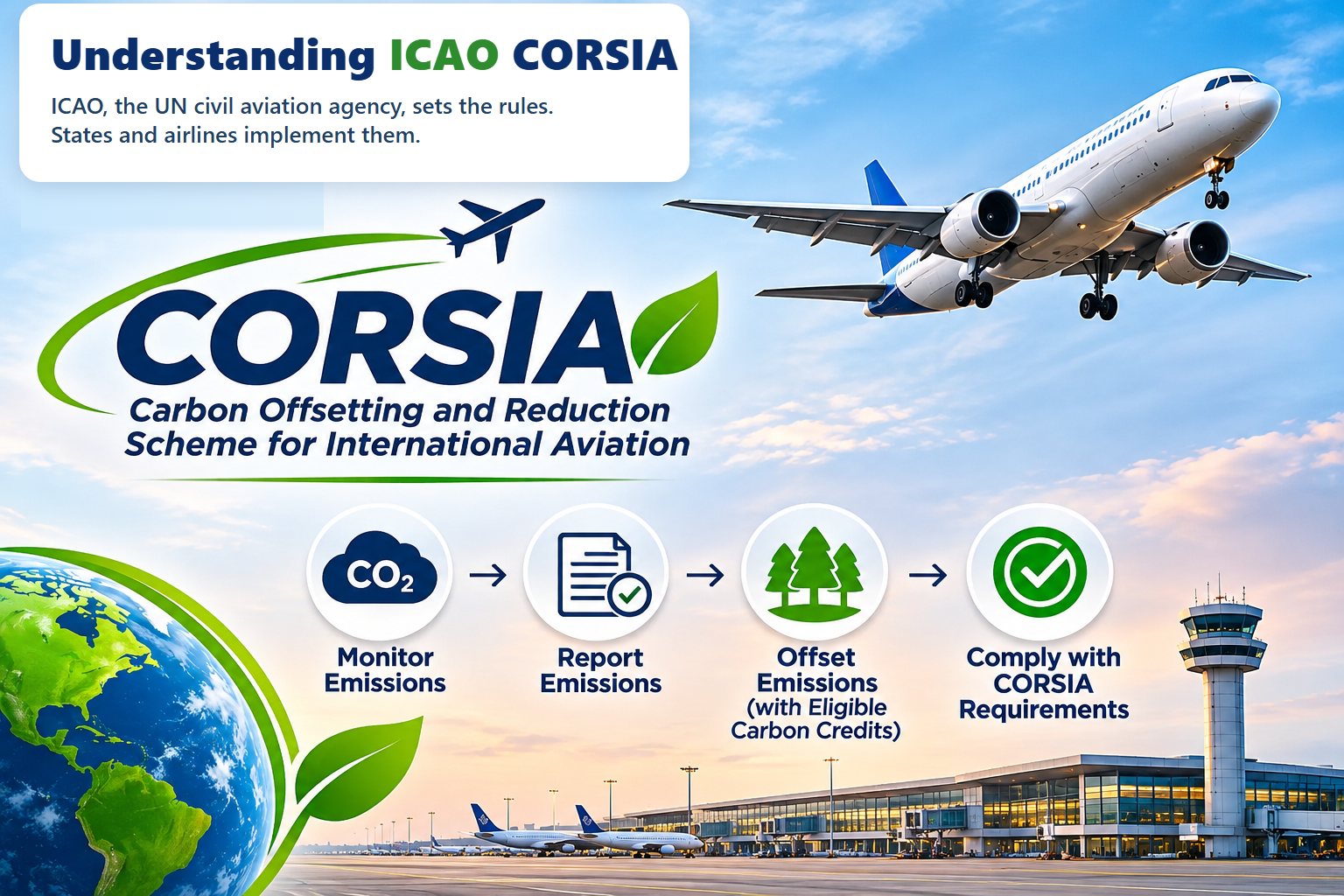
What is ICAO CORSIA? ICAO is the International Civil Aviation Organization, the UN agency for civil aviation. CORSIA, the Carbon Offsetting and Reduction Scheme for International Aviation, is the global scheme that ICAO's Member States adopted in 2016 to address growth in CO₂ from international flights. ICAO sets the rules: monitoring and reporting standards, the offsetting baseline, and which carbon credits count. States apply those rules to their airlines, and airlines comply by reporting verified emissions and cancelling eligible emissions units. For more on those units, see our CORSIA Carbon Credits resources.
This guide looks at CORSIA through ICAO's eyes: how the organisation makes and updates the rules, which bodies do what, and what that means for airlines and carbon market participants. It reflects ICAO documents and decisions available in November 2026.
What Is ICAO CORSIA?
ICAO: the organisation
- Full form: International Civil Aviation Organization.
- Founded: under the Convention on International Civil Aviation, signed in Chicago in 1944. ICAO became a UN specialised agency in 1947.
- Members: 193 Member States.
- Headquarters: Montréal, Canada.
- Role: ICAO sets global Standards and Recommended Practices (SARPs) for civil aviation, covering safety, security, air navigation and environmental protection. It does not regulate airlines directly. Each State turns the SARPs into national law.
CORSIA: the scheme
- Full form: Carbon Offsetting and Reduction Scheme for International Aviation.
- Adopted: at the 39th ICAO Assembly in 2016.
- Rules: set out in Annex 16, Volume IV to the Chicago Convention, adopted by the ICAO Council in 2018.
- Objective: to address growth in CO₂ emissions from international aviation above a baseline, by requiring covered airlines to offset that growth.
ICAO and CORSIA are not the same thing. ICAO is the international organisation. CORSIA is one scheme created under its framework, alongside ICAO's work on aircraft standards, fuels and operations.
What Is the Role of ICAO in CORSIA?
ICAO's role is to create, maintain and update the CORSIA framework. It works through several bodies:
- The ICAO Assembly, which meets every three years and sets overall policy, such as adopting CORSIA in 2016 and setting the 85%-of-2019 baseline in 2022.
- The ICAO Council, the governing body, which adopts the CORSIA SARPs, approves eligible emissions unit programmes and publishes key documents.
- The Committee on Aviation Environmental Protection (CAEP), a technical committee of the Council, which develops methods such as fuel life-cycle calculations and supports periodic reviews.
- The Technical Advisory Body (TAB), which assesses carbon-crediting programmes and recommends which should be eligible.
Through these bodies, ICAO has developed:
- monitoring, reporting and verification (MRV) requirements for airlines
- the offsetting rules and growth factor methods
- the Emissions Unit Eligibility Criteria for carbon credits
- sustainability criteria and life-cycle methods for CORSIA eligible fuels
ICAO's CORSIA implementation documents
Annex 16, Volume IV refers to a set of ICAO documents, known as CORSIA implementation elements, which ICAO updates over time:
- CORSIA States for Chapter 3 State Pairs: which State pairs are subject to offsetting each year
- ICAO CORSIA CO₂ Estimation and Reporting Tool (CERT): a simplified tool for smaller emitters
- CORSIA Eligible Fuels documents: sustainability criteria, default life-cycle values and the methodology for actual values
- CORSIA Eligible Emissions Units documents: the eligibility criteria and the list of approved programmes and conditions
- CORSIA Central Registry: ICAO's central database of CORSIA information reported by States
Because these documents change, airlines and buyers must always check the latest editions rather than rely on older copies.
Periodic reviews
ICAO reviews CORSIA every three years. The 2025 periodic review looked at the supply, demand and prices of eligible fuels and units, and was noted by the 42nd ICAO Assembly in 2025, which reaffirmed CORSIA as the only global market-based measure for international aviation.
Capacity building
ICAO also runs the ACT-CORSIA programme (Assistance, Capacity-building and Training), which helps States set up the systems they need to implement CORSIA.
Why Did ICAO Introduce CORSIA?
- Growth in international air transport. Demand for international flights has grown for decades and is expected to keep growing.
- Rising aviation CO₂. Aviation is commonly estimated to account for around 2–3% of global CO₂ emissions.
- A gap in national targets. International aviation emissions are not part of countries' Paris Agreement targets, which cover emissions within their borders.
- The need for coordination. Without a global measure, airlines could face overlapping national charges on the same flight.
- Climate action in aviation. In 2010, ICAO members set aspirational goals for fuel efficiency and carbon-neutral growth. CORSIA was designed as the market-based measure to help meet the growth goal.
ICAO's approach combines four groups of measures: aircraft technology, operational improvements, sustainable aviation fuels and market-based measures. CORSIA is the market-based measure. It complements, rather than replaces, the others.
How Does ICAO CORSIA Work?
- Identify applicable operators and routes. Operators with more than 10,000 tonnes of CO₂ a year from international flights, using aeroplanes above 5,700 kg, are in scope. Offsetting applies to routes between participating States.
- Monitor fuel consumption under an approved Emissions Monitoring Plan.
- Calculate CO₂, using ICAO's factors, such as 3.16 tonnes of CO₂ per tonne of Jet-A or Jet-A1 fuel.
- Report emissions to the national authority each year.
- Verify the report through an accredited, independent verification body.
- Determine offsetting obligations. The national authority applies ICAO's growth factors to emissions on covered routes.
- Acquire eligible emissions units where an obligation exists.
- Cancel eligible units in programme registries and report the cancellation.
Steps 1 to 5 are monitoring and reporting obligations, which apply to all in-scope operators. Steps 6 to 8 are offsetting obligations, which apply only to emissions on covered routes. Our step-by-step guide on how CORSIA works explains the calculations in more detail.
What Are ICAO CORSIA Requirements?
- Emissions Monitoring Plan: approved by the national authority.
- Fuel consumption monitoring: using an approved fuel use monitoring method, or CERT for smaller emitters within thresholds.
- CO₂ emissions reporting: an annual report by State pair, generally due by 30 April of the following year.
- Independent verification: by an accredited verification body.
- Offsetting obligations: calculated by the State for covered routes.
- Eligible emissions units: only units meeting ICAO's conditions count.
- Registry and cancellation requirements: units cancelled with a record of the operator and compliance period.
- Compliance documentation: including a verified Emissions Unit Cancellation Report.
Applicable obligations depend on the operator, its routes and the current rules. Our guide to CORSIA requirements explains each requirement in detail.
ICAO CORSIA Compliance Phases
Pilot Phase (2021–2023)
- Implementation: offsetting began, after MRV had started in 2019.
- Participation: voluntary for States.
- Main features: after the pandemic, the ICAO Council decided in 2020 to use 2019 emissions as the baseline for this phase. Eligible units had vintages from 2016 to 2020.
First Phase (2024–2026)
- Participation: still voluntary. More than 100 States take part.
- Offsetting: the 41st Assembly set the baseline at 85% of 2019 emissions from 2024. Eligible units need vintages from 2021 to 2026, host-country authorisation and a corresponding adjustment.
- Deadline: units for 2024–2026 must be cancelled by January 2028.
Second Phase (2027–2035)
- Participation: mandatory for States whose share of international revenue tonne kilometres exceeds set thresholds.
- Exemptions: least developed countries, small island developing states and landlocked developing countries, unless they volunteer.
- Compliance periods: three-year periods, starting with 2027–2029.
The pilot phase rules are now historical. First-phase obligations are being settled, and second-phase rules continue to be refined through ICAO decisions.
What Are CORSIA Eligible Emissions Units?
Eligible Emissions Units (EEUs) are carbon credits that airlines can cancel to meet their offsetting obligations. Each generally represents one tonne of CO₂ equivalent reduced or removed.
ICAO's role: the TAB assesses carbon-crediting programmes against the Emissions Unit Eligibility Criteria, and the ICAO Council approves programmes for specific compliance periods. ICAO's April 2026 edition of CORSIA Eligible Emissions Units lists ten programmes for the first phase, including the American Carbon Registry, the Climate Action Reserve, the Global Carbon Council, Gold Standard and Verra.
Two levels of eligibility:
- Programme-level approval: the programme may supply eligible units.
- Individual-unit eligibility: each credit must also meet the period's conditions.
Vintage requirements: first-phase units generally need vintages from 2021 to 2026. A unit from an earlier vintage cannot be used for the first phase.
Host-country authorisation and corresponding adjustments: first-phase units need a Letter of Authorisation from the country where the project is located, and that country must apply a corresponding adjustment under Article 6 of the Paris Agreement, so the reduction is not counted twice. Some programmes accept approved compensation arrangements where the adjustment is still pending.
Ordinary voluntary carbon credits are not automatically eligible. Our guide to CORSIA eligible emissions units lists the approved programmes and their conditions.
What Is the ICAO Technical Advisory Body (TAB)?
TAB stands for Technical Advisory Body. It is a group of experts that began its work in 2019.
What it does:
- receives applications from carbon-crediting programmes
- assesses them against the Emissions Unit Eligibility Criteria
- reviews programme design, governance, registries, methodologies and safeguards
- recommends whether programmes should be eligible, and under which conditions
- reviews changes that approved programmes make later
How it supports ICAO decisions: the TAB's recommendations go to the ICAO Council, which makes the final decision and publishes it in the CORSIA Eligible Emissions Units document. The TAB published further recommendations in September 2026, covering programmes for future compliance periods.
Why it matters for buyers: eligibility can change after each TAB cycle and Council decision. Always refer to the latest official ICAO document before buying units.
ICAO CORSIA vs Voluntary Carbon Markets
- CORSIA compliance units: credits from ICAO-approved programmes that meet unit-level conditions, cancelled to meet airline obligations.
- Ordinary voluntary carbon credits: bought by choice for climate claims, under the issuing programme's rules and the buyer's own criteria.
- Eligible emissions unit programmes: programmes such as Verra or Gold Standard can issue both voluntary credits and CORSIA eligible units, but only units meeting ICAO's conditions count for CORSIA.
- National compliance carbon markets: systems such as emissions trading schemes run by individual countries or regions, with their own rules and instruments.
- Paris Agreement Article 6 mechanisms: frameworks for transfers between countries, which CORSIA draws on for host-country authorisation and corresponding adjustments.
These markets and instruments are not automatically interchangeable. A credit valid in one may not be accepted in another.
How Does ICAO CORSIA Affect Airlines?
- Emissions monitoring: airlines need reliable fuel data on every international flight.
- Reporting: annual verified reports, by State pair.
- Verification: engagement with accredited verifiers each year.
- Offsetting: obligations on routes between participating States, growing as more States join from 2027.
- Carbon credit procurement: buying eligible units in a market where authorised supply is limited. IATA estimated first-phase demand at 200–250 million units, against about 72 million covered by compatible authorisations in August 2026.
- Costs and planning: first-phase unit assessments moved from about US$19 in January 2026 to about US$13 in November 2026 (Fastmarkets).
- Long-term strategy: using sustainable aviation fuel and efficiency measures reduces offsetting obligations over time.
Our guide to CORSIA aviation looks at these effects from the airline industry's side.
Benefits of ICAO CORSIA for the Aviation Industry
- International cooperation: one framework agreed by ICAO's Member States.
- Emissions transparency: consistent, verified data since 2019.
- Standardised monitoring and reporting across airlines and countries.
- Carbon market development: demand for high-integrity, authorised units.
- Support for projects: finance for eligible emission reduction and removal activities.
- Climate accountability: a clear obligation tied to emissions growth.
Offsetting alone does not eliminate aviation emissions. It addresses growth while the sector works on direct reductions.
Challenges in Implementing ICAO CORSIA
- Availability of eligible units, especially those with host-country authorisation
- Carbon credit integrity, which remains under scrutiny
- Regulatory complexity, with ICAO, national and programme-level rules
- Monitoring and verification, especially for complex fleets
- Double-counting risks, managed through authorisation and corresponding adjustments
- Host-country authorisation, which depends on each country's Article 6 process
- Compliance costs and price volatility
- International coordination, as States implement CORSIA through different national systems
Future Developments in ICAO CORSIA
Confirmed updates:
- The second phase begins on 1 January 2027.
- ICAO has approved emissions unit programmes for 2027–2029 and the Council has conditionally approved the Paris Agreement Crediting Mechanism.
- ICAO members adopted a long-term aspirational goal of net-zero carbon emissions from international aviation by 2050 in 2022.
- In 2023, ICAO's CAAF/3 conference agreed to aim for a 5% reduction in the carbon intensity of international aviation fuel by 2030.
Forecasts and proposals, not certainties:
- further updates to unit eligibility criteria in future periodic reviews
- wider Article 6 authorisation by host countries, which could ease supply
- faster growth of sustainable aviation fuel
- stricter integrity expectations in international carbon markets
- future ICAO decisions on what happens after 2035
Frequently Asked Questions
What is ICAO CORSIA?
CORSIA is the Carbon Offsetting and Reduction Scheme for International Aviation, a global scheme adopted by ICAO's Member States in 2016 to address growth in CO₂ emissions from international flights.
What does CORSIA stand for in ICAO?
Carbon Offsetting and Reduction Scheme for International Aviation. ICAO itself stands for the International Civil Aviation Organization.
Why did ICAO introduce CORSIA?
Because international aviation emissions are growing, fall outside national climate targets and needed one global framework instead of conflicting national measures.
How does ICAO CORSIA work?
Covered airlines monitor, report and verify CO₂ from international flights each year. On routes between participating States, they offset growth above the baseline by cancelling eligible emissions units.
What are the main ICAO CORSIA requirements?
An approved monitoring plan, fuel monitoring, annual verified emissions reports and, for covered routes, cancellation of eligible units with a verified cancellation report.
What is the role of ICAO in CORSIA compliance?
ICAO sets the rules, approves eligible programmes and publishes the implementation documents. States enforce the rules on their airlines, and airlines carry out compliance.
What are CORSIA eligible emissions units?
Carbon credits from ICAO-approved programmes that meet the compliance period's conditions, including vintage, host-country authorisation and a CORSIA label in the registry.
What is the ICAO Technical Advisory Body?
A group of experts that assesses carbon-crediting programmes against ICAO's eligibility criteria and recommends to the ICAO Council which should be approved for CORSIA.
Does ICAO CORSIA apply to all international airlines?
No. Monitoring and reporting apply to operators above the 10,000-tonne threshold. Offsetting applies only to their routes between participating States, and some flights and new entrants are exempt.
How does ICAO CORSIA support sustainable aviation?
It addresses emissions growth while cleaner fuels and aircraft develop, and reduces airlines' offsetting obligations when they use CORSIA eligible fuels.
Conclusion
ICAO CORSIA combines a global organisation and a global scheme. ICAO provides the machinery: the Assembly sets policy, the Council adopts the standards and approves eligible programmes, CAEP supplies the technical methods, and the TAB assesses carbon-crediting programmes. CORSIA is the rulebook that machinery produces for international aviation emissions.
States put those rules into national law, and airlines carry them out by monitoring, reporting and verifying their international emissions and, on routes between participating States, cancelling CORSIA Eligible Emissions Units. Because ICAO updates its documents and eligible unit lists regularly, the most important habit for airlines and buyers is simple: always work from the latest official ICAO information.
Our guide to CORSIA explained covers the scheme's basics for beginners. To learn more about CORSIA carbon credits and airline compliance, explore the resources at CORSIA Carbon Credit.
Sources
- ICAO – CORSIA Eligible Emissions Units
- ICAO – CORSIA Eligible Emissions Units document (April 2026)
- ICAO – TAB recommendations, September 2026
- ICAO – CORSIA States for Chapter 3 State Pairs
- ICAO – CORSIA news and updates
- EASA – ICAO Carbon Offsetting and Reduction Scheme for International Aviation (CORSIA)
- IATA – ICAO 42nd Assembly: key environment-related outcomes
- UNFCCC – Article 6 of the Paris Agreement
- IATA / EuropaWire – ICAO joins alliance to address CORSIA supply shortfall (13 October 2026)
- Fastmarkets – CORSIA prices tick higher on increased buyer inquiries (November 2026)