 DSTechnoverse company
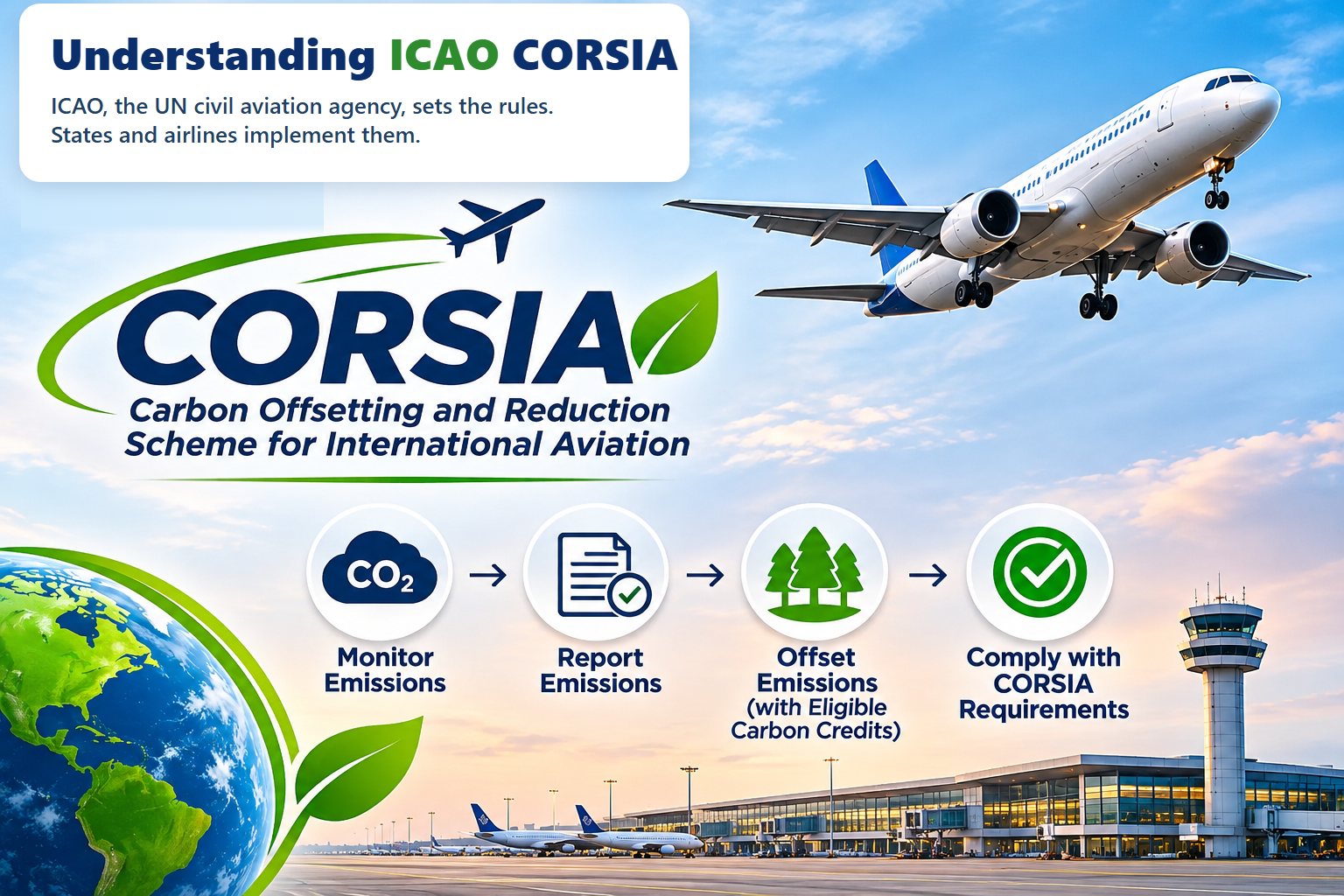
What is CORSIA in aviation? CORSIA, the Carbon Offsetting and Reduction Scheme for International Aviation, is the global scheme through which ICAO Member States address CO₂ from international flights. Covered airlines monitor, report and verify their international emissions every year, and offset growth above a baseline of 85% of 2019 levels on routes between participating States, by cancelling CORSIA Eligible Emissions Units. It sits alongside cleaner fuels, more efficient aircraft and better operations, which are the measures that actually cut aviation's emissions. For more on the units involved, see our CORSIA Carbon Credits resources.
This guide explains CORSIA aviation from the industry's side: where airline emissions come from, how the scheme works for operators, who is covered, and how CORSIA fits with the other ways the sector is trying to decarbonise. It reflects ICAO rules and market data available in November 2026.
What Is CORSIA in Aviation?
CORSIA stands for the Carbon Offsetting and Reduction Scheme for International Aviation. It was adopted by the International Civil Aviation Organization (ICAO) at its 39th Assembly in 2016, and its detailed rules are set out in Annex 16, Volume IV to the Chicago Convention.
It was introduced because:
- international aviation emissions fall outside countries' national climate targets
- airlines needed one global framework rather than a patchwork of national measures
- the sector's emissions were expected to keep growing with demand
Its main purpose in the aviation industry is to address the growth of CO₂ emissions from international flights. It does this by requiring covered airlines to compensate for that growth with approved carbon credits, while the industry develops cleaner fuels and technologies.
Why Does the Aviation Industry Need CORSIA?
Growth in air travel and fuel demand
International air travel has grown steadily for decades, and fuel use has grown with it. Each new route and each additional flight burns more jet fuel.
CO₂ from aircraft operations
Burning jet fuel releases CO₂ in a fixed ratio: about 3.16 tonnes of CO₂ for every tonne of Jet-A or Jet-A1, according to ICAO's conversion factor. Aviation as a whole is commonly estimated to produce around 2–3% of global CO₂ emissions.
Why aviation is hard to decarbonise
- Aircraft last for decades, so efficiency gains spread slowly through fleets.
- Long-haul flights need dense liquid fuel, and electric or hydrogen aircraft are not yet ready for them.
- Sustainable aviation fuel (SAF) is still a small share of supply and costs more than conventional fuel.
The need for international coordination
A flight from Mumbai to Singapore crosses national borders. Without a coordinated approach agreed through ICAO, airlines could face several overlapping national charges on the same flight. CORSIA gives the sector a common rulebook for international aviation emissions, as part of wider global climate action.
How Does CORSIA Work in the Aviation Industry?
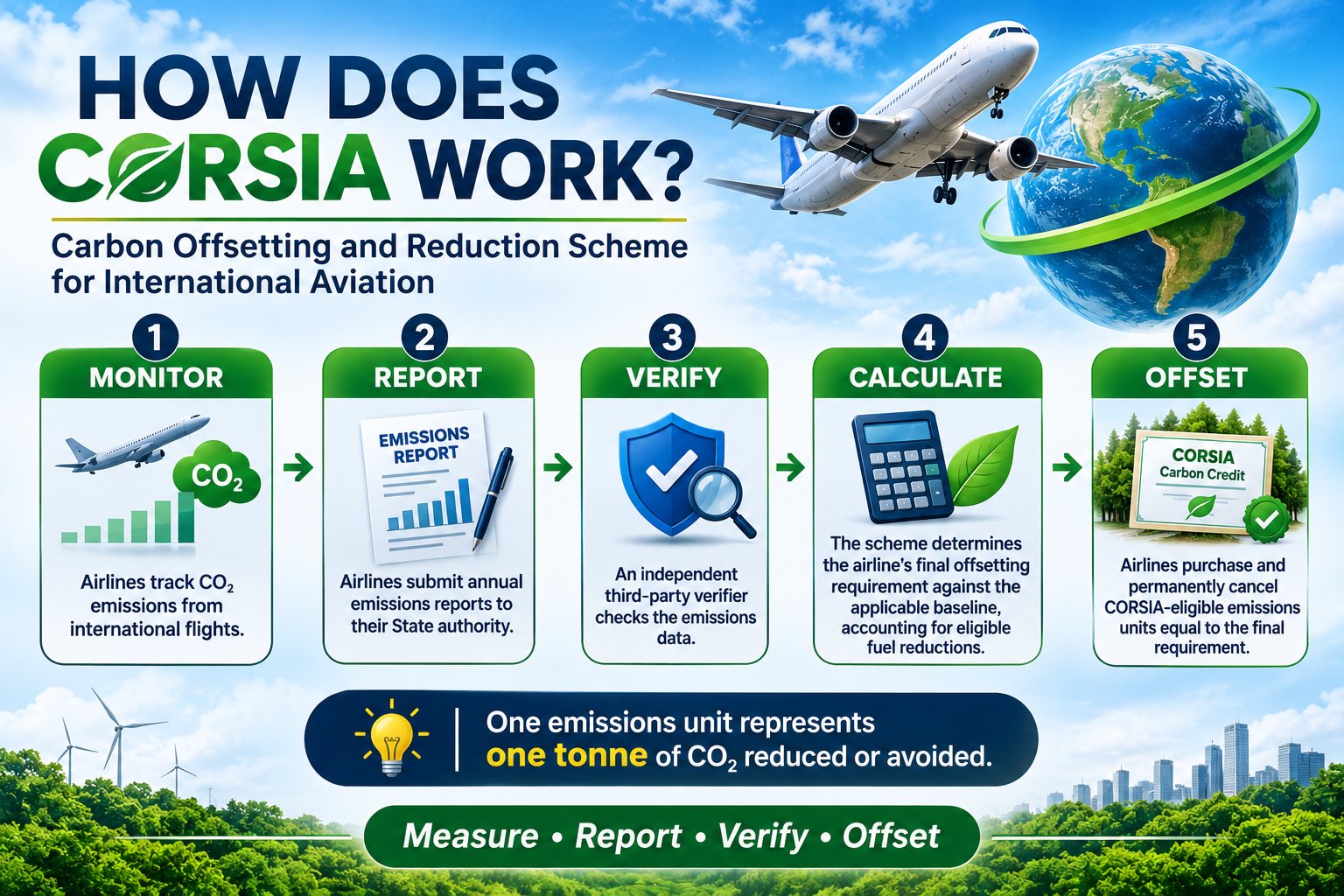
- Identify operators and routes. CORSIA applies to operators with more than 10,000 tonnes of CO₂ a year from international flights, and offsetting applies only to routes between participating States.
- Monitor fuel consumption on every international flight.
- Calculate CO₂ from fuel burned, using ICAO's factors.
- Report emissions to the national authority each year.
- Verify the report through an accredited, independent verification body.
- Determine offsetting obligations, calculated by the national authority.
- Acquire eligible emissions units where an obligation exists.
- Cancel eligible units in the programme registry and report the cancellation.
Steps 1 to 5 are monitoring and reporting obligations, which apply to every covered operator each year. Steps 6 to 8 are offsetting obligations, which apply only to emissions on covered routes and are settled once per compliance period.
Who Is Covered Under CORSIA Aviation Regulations?
Aeroplane operators
- operators with more than 10,000 tonnes of CO₂ a year from international flights
- using aeroplanes with a maximum take-off mass above 5,700 kg
Participating States
Each operator is attributed to a State, which approves its monitoring plan, reviews its reports and calculates any offsetting requirement. In India, CORSIA is administered by the Directorate General of Civil Aviation (DGCA).
International route coverage
- Domestic flights are outside CORSIA.
- Flights between two participating States count towards offsetting.
- Flights involving a non-participating State are monitored and reported only.
Exemptions and thresholds
- humanitarian, medical and firefighting flights
- operators below the emissions threshold
- new entrants, for their first three years or until they reach 0.1% of total international revenue tonne kilometres
How participation is determined
During the voluntary phases (2021–2026), each State chose whether to participate. From 2027, participation is mandatory for States with significant shares of international aviation activity, with exemptions for least developed countries, small island developing states and landlocked developing countries unless they volunteer.
CORSIA does not automatically cover every airline or every flight.
CORSIA Requirements for Airlines
CORSIA airline requirements include:
- Emissions Monitoring Plan, approved by the national authority
- fuel consumption records for every international flight
- CO₂ calculations using ICAO's conversion factors
- annual emissions reporting, generally due by 30 April of the following year
- independent verification of each report
- offsetting obligations, where routes are covered
- eligible emissions units, cancelled to meet those obligations
- compliance documentation, including an Emissions Unit Cancellation Report
CORSIA compliance for airlines affects more than the sustainability team. It touches fuel data systems, finance, procurement and network planning. Our guide to CORSIA requirements covers each obligation in detail.
How Does CORSIA Measure Aviation Carbon Emissions?
From fuel to CO₂
CORSIA measures aviation carbon emissions from the fuel burned. Because combustion releases CO₂ in a fixed ratio, accurate fuel data gives an accurate emissions figure.
Monitoring, Reporting and Verification (MRV)
- Monitoring: airlines use an approved fuel use monitoring method, such as measuring fuel at block-off and block-on, or using fuel uplift records. Smaller emitters may use ICAO's CORSIA CO₂ Estimation and Reporting Tool (CERT), within set thresholds.
- Data collection: fuel data comes from flight management systems, fuel slips and technical logs.
- Reporting: an annual report breaks emissions down by State pair.
- Verification: an accredited verifier checks data, methods and calculations.
Educational example
This is an educational illustration, not an official compliance calculation.
A narrowbody aircraft burns 10 tonnes of Jet-A1 on an international flight.
- CO₂ emitted: 10 × 3.16 = 31.6 tonnes
- With 200 passengers on board, that is roughly 158 kg of CO₂ per passenger
Official CORSIA reporting follows the airline's approved monitoring method and ICAO's detailed rules, not simplified estimates like this.
What Are CORSIA Carbon Credits for Aviation?
CORSIA carbon credits are formally called CORSIA Eligible Emissions Units (EEUs). Each generally represents one tonne of CO₂ equivalent reduced or removed by a project, such as methane capture or forest protection.
How eligibility works:
- Programme level: the ICAO Council, advised by its Technical Advisory Body (TAB), approves carbon-crediting programmes for specific compliance periods.
- Unit level: each credit must meet that period's conditions. For the first phase (2024–2026), these generally include activities started on or after 1 January 2016, vintages from 2021 to 2026, host-country authorisation with a corresponding adjustment under Article 6 of the Paris Agreement, and a CORSIA label in the registry.
Ordinary voluntary carbon credits are not automatically eligible. Approved programmes listed in ICAO's April 2026 document include the American Carbon Registry, the Climate Action Reserve, the Global Carbon Council, Gold Standard and Verra, among others, each with conditions. Our guide to CORSIA eligible emissions units explains the full list and checks.
CORSIA Phases and Their Impact on Aviation
Pilot Phase (2021–2023)
- Participation: voluntary for States.
- Implementation: offsetting began, with a baseline of 2019 emissions after ICAO excluded the pandemic-affected 2020. Eligible units had vintages from 2016 to 2020.
- Impact: airlines gained experience with offsetting, but traffic was still recovering from the pandemic.
First Phase (2024–2026)
- Participation: still voluntary. More than 100 States take part.
- Offset obligations: based on a baseline of 85% of 2019 emissions, with stricter unit conditions including host-country authorisation.
- Impact: demand for authorised units has exceeded supply. IATA estimated first-phase demand at 200–250 million units, against about 72 million covered by compatible authorisations in August 2026. Units must be cancelled by January 2028.
Second Phase (2027–2035)
- Participation: mandatory for most States with significant international aviation.
- Exemptions: least developed countries, small island developing states and landlocked developing countries, unless they volunteer, and States with very small shares of activity.
- Impact: many more routes become subject to offsetting. Large markets that did not volunteer earlier, such as India, join from 2027.
CORSIA vs Other Aviation Carbon Reduction Strategies
These strategies are not interchangeable. They work in different ways and complement each other:
- Sustainable Aviation Fuel (SAF): reduces life-cycle emissions from the fuel itself. Under CORSIA, CORSIA eligible fuels also reduce an airline's offsetting requirement. In 2023, ICAO members agreed to aim for a 5% reduction in the carbon intensity of international aviation fuel by 2030. Our guide to CORSIA actual life cycle emissions values explains how fuel emissions are calculated.
- Aircraft fuel efficiency: new aircraft and engines burn less fuel per seat, supported by ICAO's CO₂ standard for new aircraft.
- Operational efficiency: better routing, air traffic management, single-engine taxiing and weight reduction cut fuel burn.
- Electric and hydrogen aircraft: may help on shorter routes in future, but are not yet in commercial service at scale.
- Voluntary carbon offsetting: some airlines let passengers or corporate customers buy voluntary offsets. This is separate from CORSIA compliance. Voluntary offsets cannot count towards an airline's CORSIA obligation unless they are eligible units cancelled for CORSIA.
CORSIA compensates for growth. The other strategies reduce emissions at the source. Long-term aviation decarbonization depends mainly on fuels, technology and operations.
Benefits of CORSIA for the Aviation Industry
- International cooperation: one ICAO framework for flights that cross borders.
- Improved emissions transparency: verified annual data from airlines since 2019.
- Carbon market development: demand for high-integrity, authorised units.
- Support for projects: finance for emission reduction and removal projects worldwide.
- Climate accountability: a measurable obligation for emissions growth.
- Long-term sustainability: a bridge while cleaner fuels and aircraft scale up.
Carbon offsetting alone does not eliminate aviation emissions. It compensates for growth while the sector works on direct reductions.
Challenges of Implementing CORSIA in Aviation
- Carbon credit quality and integrity: offsets remain under public and scientific scrutiny.
- Availability of eligible units: authorised supply has lagged airline demand.
- Regulatory complexity: programme approvals, unit conditions and phase rules change.
- Compliance costs: first-phase units were assessed at about US$19 in January 2026 and US$13 in November 2026 (Fastmarkets).
- Emissions data management: consistent fuel data across mixed fleets and outsourced operations.
- Verification challenges: resolving data gaps and errors before deadlines.
- International coordination: States implement CORSIA through different national rules.
- Double-counting risks: managed through host-country authorisation and corresponding adjustments.
Our guide to the CORSIA carbon market explains how supply, demand and prices interact.
Future of CORSIA and Sustainable Aviation
Confirmed developments:
- The second phase begins on 1 January 2027, with mandatory participation for most States with significant international aviation.
- ICAO has approved emissions unit programmes for 2027–2029 and continues to assess others.
- ICAO members adopted a long-term aspirational goal of net-zero carbon emissions from international aviation by 2050 in 2022.
- The 42nd ICAO Assembly in 2025 reaffirmed CORSIA as the only global market-based measure for international aviation.
Forecasts and possibilities:
- continued growth in international air traffic
- wider SAF adoption, reducing reliance on offsets
- more host countries issuing Article 6 authorisations, easing unit supply
- more carbon removal units in eligible supply
- stricter integrity requirements for carbon credits
- future ICAO decisions on what happens after 2035
Frequently Asked Questions
What does CORSIA mean in aviation?
CORSIA is the Carbon Offsetting and Reduction Scheme for International Aviation, ICAO's global scheme for addressing growth in CO₂ emissions from international flights.
Why was CORSIA introduced in the aviation industry?
Because international aviation emissions fall outside national climate targets, are expected to grow, and needed one global framework instead of a patchwork of national measures.
How does CORSIA work for airlines?
Covered airlines monitor, report and verify international CO₂ each year. For routes between participating States, their State calculates an offsetting requirement, which airlines meet by cancelling eligible emissions units.
Which airlines need to follow CORSIA?
Operators with more than 10,000 tonnes of CO₂ a year from international flights, using aeroplanes above 5,700 kg maximum take-off mass. Offsetting applies only to their flights between participating States.
Does CORSIA apply to domestic flights?
No. CORSIA covers international flights only. Domestic flights are counted in countries' national climate commitments instead.
How does CORSIA monitor aviation carbon emissions?
Through fuel use: airlines record fuel burned on each international flight under an approved monitoring method, convert it to CO₂ using ICAO's factors, and have the annual report verified.
What are CORSIA eligible carbon credits?
Carbon credits from ICAO-approved programmes that meet the compliance period's conditions, including vintage, host-country authorisation and a CORSIA label in the registry.
What are the CORSIA compliance requirements for airlines?
An approved monitoring plan, annual verified emissions reports and, for covered routes, cancellation of enough eligible units to meet the offsetting requirement, followed by a cancellation report.
How does CORSIA support sustainable aviation?
It addresses emissions growth while cleaner fuels and aircraft develop, and it rewards airlines that use CORSIA eligible fuels by reducing their offsetting requirements.
What is the future of CORSIA in the aviation industry?
The second phase from 2027 brings mandatory participation for most large aviation States. Longer term, the industry expects fuels, technology and operations to deliver most reductions towards net zero by 2050.
Conclusion
CORSIA aviation is the international aviation industry's framework for managing CO₂ growth on flights between countries. Covered airlines monitor, report and verify their international emissions every year. For routes between participating States, they offset growth above the baseline by cancelling CORSIA Eligible Emissions Units that meet ICAO's programme and unit conditions.
CORSIA does not cover domestic flights, does not offset all emissions and does not replace cleaner fuels or aircraft. It works alongside them. As participation becomes mandatory for most large aviation States in 2027, understanding the scheme, and the difference between eligible units and ordinary carbon credits, is becoming part of how every international airline operates.
Our guide to CORSIA compliance explains how airlines manage these obligations across a full compliance period. To learn more about CORSIA carbon credits and airline compliance, explore the resources at CORSIA Carbon Credit.
Sources
- ICAO – CORSIA Eligible Emissions Units
- ICAO – CORSIA Eligible Emissions Units document (April 2026)
- EASA – ICAO Carbon Offsetting and Reduction Scheme for International Aviation (CORSIA)
- IATA – CORSIA fact sheet
- IATA – ICAO 42nd Assembly: key environment-related outcomes
- IEA – Aviation
- UNFCCC – Article 6 of the Paris Agreement
- ICCT – India aviation emissions inventory and CORSIA (working paper, September 2026)
- IATA / EuropaWire – ICAO joins alliance to address CORSIA supply shortfall (13 October 2026)
- Fastmarkets – CORSIA prices tick higher on increased buyer inquiries (November 2026)