 DSTechnoverse company

What is the latest CORSIA carbon credits news? As of 26 November 2026, the main stories are a shortfall of eligible units for CORSIA's first phase, an industry and ICAO alliance formed in October 2026 to speed up supply, prices for first-phase units around US$13 per tonne, and ICAO's assessment of programmes for the 2027–2029 compliance period, which begins when CORSIA's mandatory second phase starts on 1 January 2027. For background on the units themselves, see our CORSIA Carbon Credits resources.
Published 26 November 2026. Information checked on 26 November 2026. Every news item below includes its date and source. Developments are labelled as confirmed, reported or expected.
Introduction to CORSIA Carbon Credits News
CORSIA, the Carbon Offsetting and Reduction Scheme for International Aviation, is the scheme adopted by the International Civil Aviation Organization (ICAO) to address growth in CO₂ from international flights. Airlines meet their offsetting obligations by cancelling CORSIA Eligible Emissions Units (EEUs), carbon credits that meet ICAO's conditions.
News matters because the rules and the market move quickly:
- ICAO decisions change which programmes and units are eligible.
- Host-country authorisations decide how many units can be labelled.
- Prices move with supply and demand.
- Deadlines approach: units for 2024–2026 must be cancelled by January 2028.
A decision announced one month can change what an airline can buy the next.
Latest CORSIA Carbon Credit News and Updates
October–November 2026: market and industry
- 24 November 2026 (reported): carbon markets company Karbon-X announced it had joined IATA's Supporting Alliance for CORSIA Eligible Emissions Unit Supply, one of a number of companies joining the alliance. Source: company press release.
- 18 November 2026 (reported): Fastmarkets assessed CORSIA Phase 1 spot units at US$13.00 per tonne, with bids at US$12.50–12.95. It said more than 55 million tonnes had been tagged as Phase 1 eligible, still well below forecast demand. Source: Fastmarkets.
- 2 November 2026 (reported): S&P Global launched separate price assessments for CORSIA Phase 2 units, reflecting the move towards the second phase. Source: market reporting on S&P Global.
- 13 October 2026 (confirmed): ICAO joined the IATA-backed Supporting Alliance for CORSIA Eligible Emissions Unit Supply, which brings together airlines, suppliers and other participants. The alliance aims to help make 225–250 million eligible units available by spring 2027. Source: IATA, via EuropaWire and Travel PR News.
September 2026: supply and ICAO assessments
- September 2026 (confirmed): IATA estimated that airlines could need 200–250 million units for the first phase, while only about 72 million units were covered by 42 compatible Letters of Authorisation from host countries as of August 2026. Source: IATA.
- September 2026 (confirmed): ICAO's Technical Advisory Body (TAB) published recommendations from its 2026 assessment cycle, covering programmes applying to supply units for the 2027–2029 compliance period. ICAO also published updated TAB Procedures (version 9). Source: ICAO TAB documents, September 2026.
- August–September 2026 (confirmed): ICAO's CORSIA newsletter reported that about 44 million units had been labelled as CORSIA eligible for the first phase, that four programmes were approved for 2027–2029 at that point, and that the Council had conditionally approved the Paris Agreement Crediting Mechanism (PACM) for both the first phase and 2027–2029. Source: ICAO CORSIA Newsletter, August–September 2026.
The 72 million figure counts units covered by government authorisations, not units already bought and cancelled by airlines. Different sources count labelled supply differently, which explains the gap between ICAO's 44 million and Fastmarkets' 55 million at different dates.
Recent ICAO Updates Affecting CORSIA
- November 2026 (expected): ICAO said the ICAO Council would consider the TAB's September 2026 recommendations at its November 2026 session. Check ICAO's TAB and Eligible Emissions Units pages to confirm the final decision and any updated programme list.
- April 2026 (confirmed): the Council accepted TAB recommendations submitted in January 2026, and ICAO published an updated edition of the CORSIA Eligible Emissions Units document. That April 2026 edition lists ten programmes approved for the first phase.
- 1 January 2026 (confirmed): 130 States were participating in CORSIA, up from 126 in 2024. ICAO lists 134 States for 2027.
- October 2025 (confirmed): at its 236th session, the Council accepted the TAB's 2025 recommendations and extended the vintage-date eligibility parameter for the 2027–2029 compliance period.
- 2025 (confirmed): the 42nd ICAO Assembly adopted Resolution A42-22, reaffirming CORSIA as the only global market-based measure for international aviation, and noted the 2025 periodic review of supply, demand and prices for eligible fuels and units.
ICAO also continues capacity-building work. For example, its EUR/NAT office held a webinar on eligible units and Letters of Authorisation in October 2026.
CORSIA Eligible Emissions Units: Latest Developments
Approved programmes
ICAO's April 2026 document lists ten programmes for the first phase (2024–2026):
- American Carbon Registry
- Architecture for REDD+ Transactions
- BioCarbon Fund Initiative for Sustainable Forest Landscapes
- Climate Action Reserve
- Forest Carbon Partnership Facility
- Global Carbon Council
- Gold Standard
- Isometric
- Premium T-VER (Thailand)
- Verra's Verified Carbon Standard
For 2027–2029, a smaller number of programmes had been approved by September 2026, with more under assessment.
Eligibility requirements
For the first phase, units generally need:
- activities starting on or after 1 January 2016
- vintages from 2021 to 2026
- host-country authorisation through a Letter of Authorisation
- a corresponding adjustment under Article 6 of the Paris Agreement, so the reduction is not counted twice
- a CORSIA label in the programme registry
Insurance as an alternative safeguard
- July 2026 (reported): Gold Standard added Blenheim, its first traditional political risk insurer, to its list of approved CORSIA insurance providers, alongside MIGA, Artio, CFC and Oka. Source: Carbon Herald.
- August 2026 (confirmed): the Climate Action Reserve published criteria for approved insurance mechanisms under CORSIA. Source: Climate Action Reserve.
These policies can stand in where a host country's corresponding adjustment is not yet confirmed. Our guide to CORSIA carbon credits insurance explains how they work.
Why programme approval is not enough
Programme approval does not make every credit eligible. A credit from an approved programme can still fail on vintage, methodology, authorisation or labelling. Our guide to CORSIA eligible emissions units explains the checks.
CORSIA Carbon Credit Market Trends
Demand
Demand is driven by airlines' first-phase obligations and the January 2028 deadline. IATA's estimate of 200–250 million units remains far above authorised supply.
Supply
Supply depends mainly on host-country authorisations. As of August 2026, 42 Letters of Authorisation covered about 72 million units (IATA). The alliance formed in October 2026 aims to close the gap by spring 2027.
Buyer preferences
Airlines and traders prefer units that are already labelled, from well-known programmes, with clear authorisation records or approved insurance.
Pricing
Price assessments, not completed transactions:
- 28 January 2026: US$19.00 per tonne (Fastmarkets)
- 1 July 2026: US$9.45, a Phase 1 low (S&P Global Platts)
- 7 October 2026: US$12.75 (S&P Global Platts)
- 18 November 2026: US$13.00 (Fastmarkets)
Prices fell sharply in the first half of 2026 as labelled supply grew, then partly recovered. Our guide to the CORSIA carbon credit price in 2026 explains what drives these movements.
Transparency and quality
Registry labels, published Letters of Authorisation, ICAO's eligible units document and price assessments have made the market more transparent. Quality concerns about some project types remain, which is why authorisation and programme conditions matter.
How CORSIA News Affects Airlines
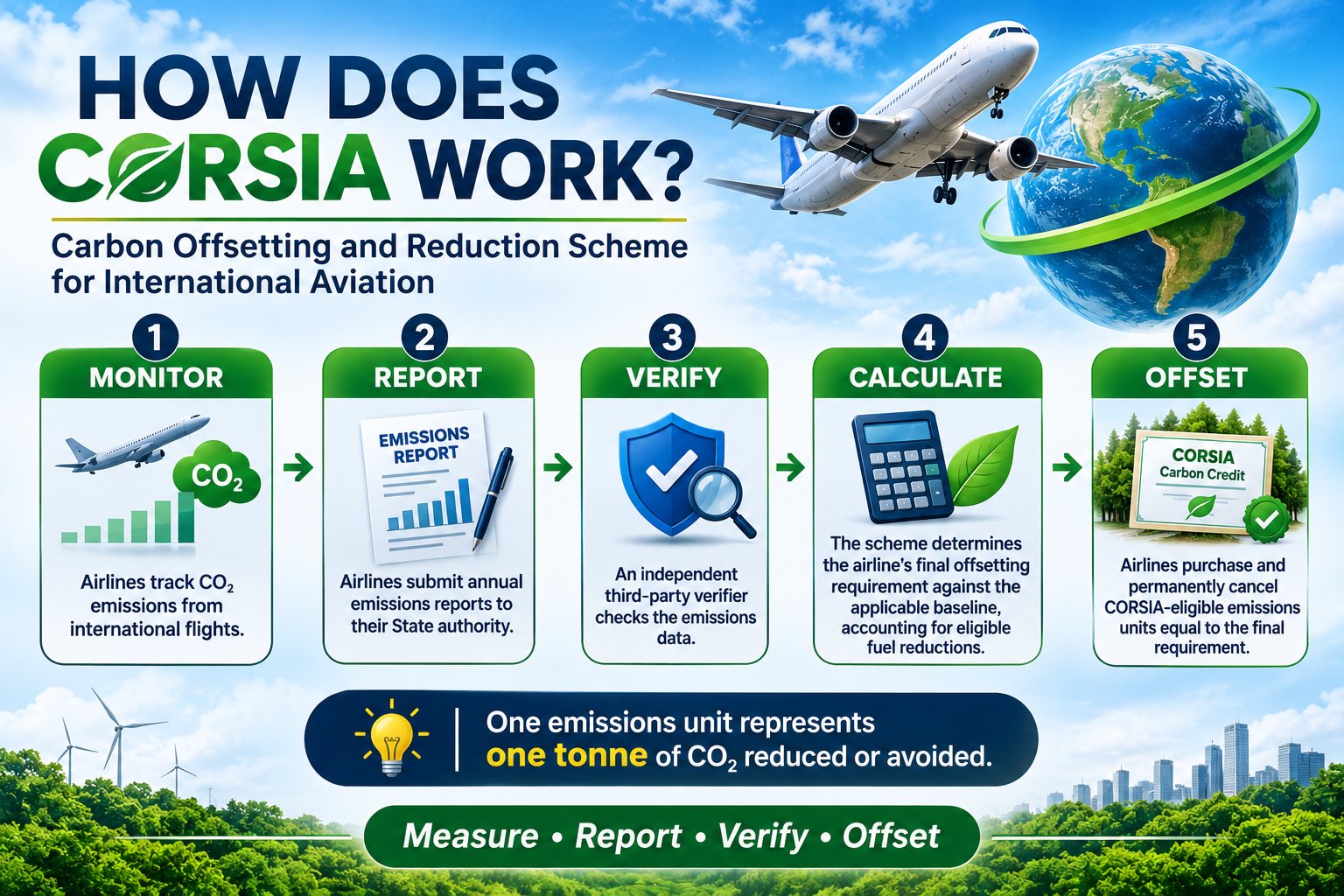
- Emissions monitoring and reporting: these obligations do not change with market news, but airlines must keep reporting accurately each year.
- Verification and compliance planning: updated ICAO documents and State pair lists affect which routes are covered and which units count.
- Carbon credit procurement: limited supply and price swings encourage early buying, forward contracts and diversified sources.
- Compliance costs: a fall from about US$19 to US$13 per unit changes budgets significantly, but prices can rise again as the deadline approaches.
- Operational decisions: sustainable aviation fuel and efficiency measures reduce the number of units needed.
CORSIA Developments and the Global Aviation Industry
- Airlines: through IATA, airlines have pressed governments to speed up Letters of Authorisation and joined the October 2026 supply alliance.
- Governments: host countries are building Article 6 authorisation processes. Large aviation markets are preparing for mandatory participation. For example, India, which did not volunteer for the earlier phases, will face offsetting requirements from 2027, according to an ICCT working paper published in September 2026.
- Regional rules: the European Commission announced a review of the EU Emissions Trading System on 17 July 2026, and IATA has published a position paper on the review, warning that regional rules should not undermine CORSIA as the global framework.
- Carbon market participants: developers, insurers, exchanges and price reporting agencies are adding CORSIA-specific products, such as insurance policies and Phase 2 price assessments.
Our guide to CORSIA carbon credits trading in India looks at what these developments mean for Indian suppliers.
Important CORSIA Changes to Watch
Confirmed decisions:
- the second phase begins on 1 January 2027, with the first compliance period running from 2027 to 2029
- first-phase units must be cancelled by January 2028
- the PACM is conditionally approved for both the first phase and 2027–2029
Expected or pending:
- the ICAO Council's decision on the TAB's September 2026 recommendations, expected at its November 2026 session
- updates to the eligible programmes list for 2027–2029
- the outcome of the EU ETS review and how it treats international flights
Developments to monitor:
- new Letters of Authorisation from host countries
- changes to programme methodologies and approval conditions
- price movements as the January 2028 deadline nears
- progress of the supply alliance towards its spring 2027 target
How to Stay Updated on CORSIA Carbon Credit News
- ICAO: the CORSIA website, the CORSIA Eligible Emissions Units document, TAB reports, Council decisions and the CORSIA newsletter.
- Programme documentation and registries: Verra, Gold Standard, the Global Carbon Council and others publish CORSIA labels, authorisation records and insurance lists.
- IATA: CORSIA updates, supply estimates and policy positions.
- UNFCCC: Article 6 authorisations and reporting.
- Price reporting agencies: such as Fastmarkets and S&P Global, for dated price assessments.
- Specialist carbon market news: such as Carbon Herald and other trade publications, checked against official sources.
Always check the date of each item, and confirm key decisions against ICAO's official documents.
Future Outlook for CORSIA Carbon Credits
- Demand will rise as more States join in 2027 and the first-phase deadline approaches.
- Supply depends on how quickly host countries issue authorisations. The alliance targets 225–250 million units by spring 2027, but that is a goal, not a forecast.
- Market participation is widening, with more insurers, exchanges and price assessments focused on CORSIA.
- Aviation decarbonisation will increasingly rely on sustainable aviation fuel and efficiency, which reduce the need for offsets over time.
Price levels and supply outcomes cannot be predicted with certainty.
Frequently Asked Questions
What is the latest news about CORSIA carbon credits?
As of 26 November 2026: a shortfall of eligible first-phase units, an ICAO-backed supply alliance formed in October 2026, Phase 1 prices around US$13 per tonne, and ICAO's assessment of programmes for 2027–2029.
Where can I find official CORSIA updates?
On ICAO's CORSIA website, including the CORSIA Eligible Emissions Units document, TAB reports, Council decisions and the CORSIA newsletter.
What are CORSIA eligible emissions units?
Carbon credits from ICAO-approved programmes that meet the compliance period's conditions, such as vintage, host-country authorisation and a CORSIA label in the registry.
Has ICAO updated its CORSIA requirements?
Yes. ICAO updated its eligible units document in April 2026, and the Council was expected to consider TAB recommendations for 2027–2029 in November 2026. Check ICAO's site for the latest decision.
How do CORSIA updates affect international airlines?
They change which units are eligible, how much supply is available and what units cost, which affects procurement plans and compliance budgets.
Is demand for CORSIA carbon credits increasing?
Yes. IATA estimated first-phase demand at 200–250 million units, far above the roughly 72 million covered by authorisations in August 2026, and demand will grow as more States join in 2027.
Do all voluntary carbon credits qualify under CORSIA?
No. Only units from ICAO-approved programmes that meet every condition for the compliance period count.
Where can airlines check eligible carbon credit programmes?
In ICAO's CORSIA Eligible Emissions Units document, which lists approved programmes and their conditions for each compliance period.
How do CORSIA developments affect carbon credit prices?
New supply tends to lower prices, while tight supply and approaching deadlines tend to raise them. Phase 1 assessments ranged from about US$9 to US$19 during 2026.
What major CORSIA developments should stakeholders watch?
The ICAO Council's decision on 2027–2029 programmes, new Letters of Authorisation, the start of the second phase in 2027, the January 2028 deadline and the EU ETS review.
Conclusion
CORSIA carbon credits news in late 2026 centres on one issue: supply. Airlines need far more eligible units than host countries have authorised, and ICAO, IATA and market participants are working to close that gap before the January 2028 deadline. Meanwhile, ICAO is preparing the programme list for the 2027–2029 period, prices have settled around US$13 after a volatile year, and the mandatory second phase begins in just over a month.
For airlines and buyers, the practical lessons are to follow official ICAO decisions closely, check every unit's eligibility, and treat market reports as dated snapshots rather than permanent facts.
Our guide to ICAO CORSIA explains how ICAO makes these decisions. To follow CORSIA carbon credit developments and learn more about eligible units, explore the resources at CORSIA Carbon Credit.
Sources
- ICAO – CORSIA Eligible Emissions Units
- ICAO – CORSIA Eligible Emissions Units document (April 2026)
- ICAO – TAB recommendations, September 2026
- ICAO – TAB Procedures, version 9 (September 2026)
- ICAO – CORSIA Newsletter, August–September 2026
- ICAO – CORSIA Newsletter, January 2026 (participating States)
- ICAO – TAB 2025 assessment and Council decision (October 2025)
- ICAO – Resolution A42-22 on CORSIA (2025)
- ICAO EUR/NAT – Webinar on CEEUs and Letters of Authorisation (October 2026)
- IATA / EuropaWire – ICAO joins alliance to address CORSIA supply shortfall (13 October 2026)
- Travel PR News – ICAO joins IATA carbon credit alliance (13 October 2026)
- FinancialContent – Karbon-X joins IATA CORSIA EEU Supply Alliance (24 November 2026)
- Fastmarkets – CORSIA prices tick higher on increased buyer inquiries (November 2026)
- S&P Global – South Korean airlines target price-driven CORSIA procurement (July 2026)
- Carbon Herald – Gold Standard adds first traditional political risk insurer to CORSIA-approved list (2026)
- Climate Action Reserve – Criteria for Approved Insurance Mechanisms under CORSIA (August 2026)
- ICCT – India aviation emissions inventory and CORSIA (working paper, September 2026)
- IATA – CORSIA
- UNFCCC – Article 6 of the Paris Agreement