 DSTechnoverse company
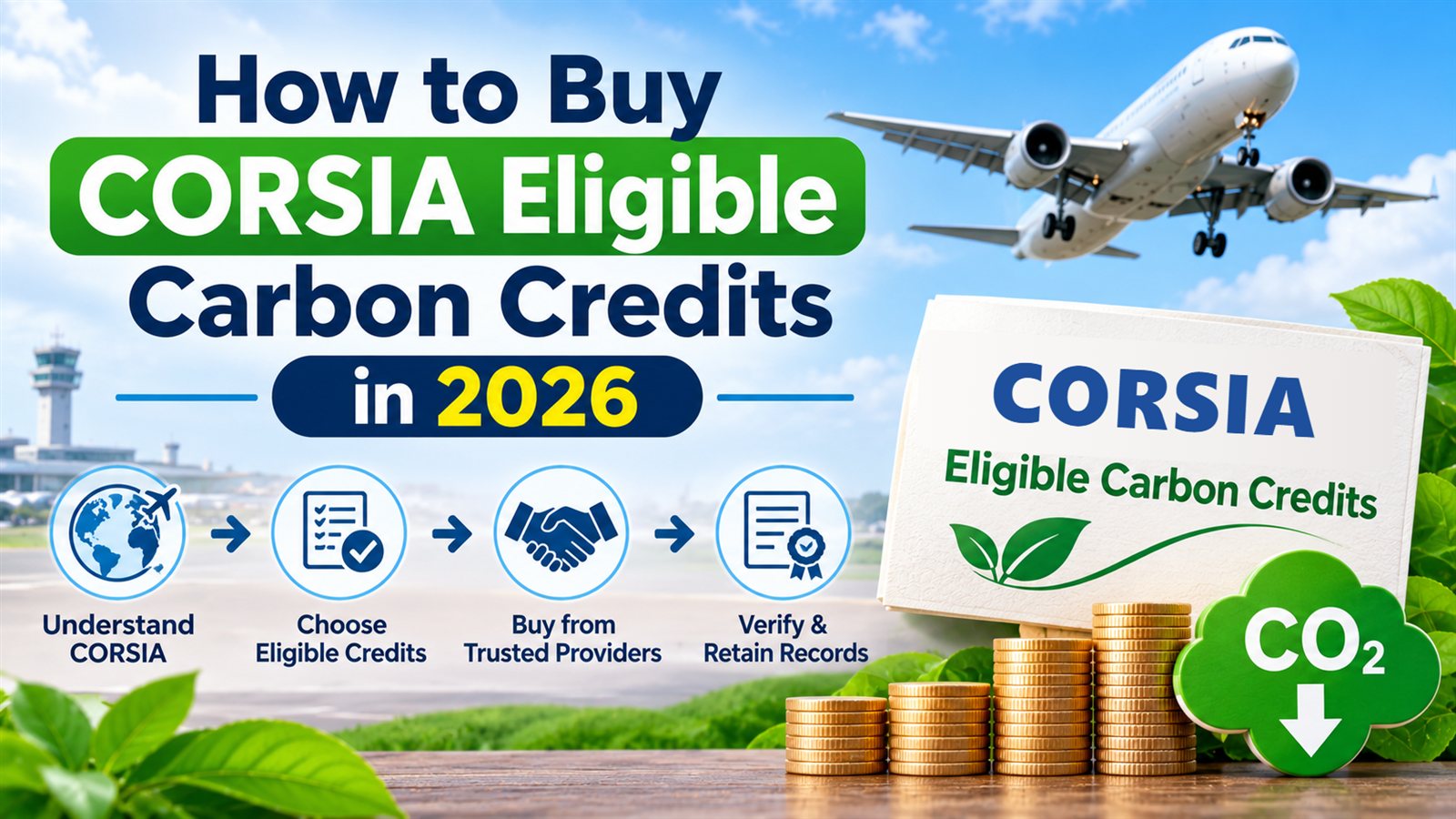
How do you buy CORSIA eligible carbon credits in 2026? You confirm how many units you need, check that each unit meets ICAO's rules for the compliance period, buy from a project developer, trader or exchange, transfer the units into an account you control, then cancel them for CORSIA and report the cancellation to your State. This guide from CORSIA Carbon Credits walks through each step in order, with the documents to ask for and the mistakes that cost buyers money.
Information in this guide was checked on 27 November 2026. CORSIA rules, approved programmes and prices change, so confirm the current position with ICAO's published documents, your national authority and your supplier before you sign anything.
If you first need to understand what makes a unit eligible, read our guide to what CORSIA eligible emissions units are. This article focuses on the buying process itself.
Who Needs to Buy CORSIA Eligible Carbon Credits?
The main buyers are aeroplane operators with offsetting requirements under CORSIA. An operator is covered when it emits more than 10,000 tonnes of CO₂ a year from international flights using aeroplanes heavier than 5,700 kg maximum take-off mass. Its offsetting requirement applies to flights between States that both participate in the offsetting phase.
Other buyers include:
- Traders and intermediaries who buy units in bulk and resell them to airlines.
- Financial institutions that trade CORSIA futures or finance forward purchases.
- Airline groups that buy centrally for several operators.
- Companies and individuals who want a high-integrity credit for voluntary use, though they do not cancel units for CORSIA compliance.
This guide is written mainly for airline procurement and sustainability teams, but the checks apply to anyone buying units labelled for CORSIA.
Where CORSIA Stands in 2026
Timing matters when you buy, because each compliance period has its own eligibility rules.
- First phase (2024–2026): this is the compliance period that ends in 2026. Units must come from an approved programme, have a vintage from 2021 to 2026, come from activities that started on or after 1 January 2016, and carry host-country authorisation with a corresponding adjustment, or an approved compensation arrangement. The programme must label them as eligible for the first phase.
- Second phase (2027–2035): the first compliance period runs from 2027 to 2029. ICAO has approved fewer programmes for this period so far, and buyers must check the conditions separately.
- Participation is growing: ICAO listed 130 participating States for 2026 and 134 for 2027. India's offsetting obligations are expected to start in 2027.
What this means for buyers: a unit labelled for the first phase is not automatically usable for 2027–2029, and the reverse also applies. Always buy against a specific compliance period.
Supply is also tight. In August 2026 IATA estimated first-phase demand at 200–250 million units, against about 72 million units covered by compatible host-country authorisations. In October 2026 ICAO joined the IATA-led alliance working to increase supply, which is targeting 225–250 million units by spring 2027.
Step 1: Confirm Your Offsetting Requirement
Before you buy anything, work out how many units you need.
- Check your coverage: confirm which of your international routes link participating States in the relevant year. Our knowledge-base page on whether an airline is covered by CORSIA explains the thresholds.
- Use your verified emissions: your offsetting requirement is based on your verified CO₂ emissions on covered routes, multiplied by the sector's growth factor. For 2024–2026 the baseline is 85% of 2019 emissions, and the growth factor is calculated for the sector as a whole.
- Wait for, or estimate, the State's figure: your State calculates your final requirement for 2024–2026 and notifies you by 30 November 2027. Many airlines buy before that date using their own estimates.
- Add a margin: buy a small buffer above your estimate, because emissions data and the growth factor can change.
Write the estimate down with its assumptions. It becomes the basis for your budget and your purchase volumes.
Step 2: Learn the Eligibility Rules for the Period
Your procurement team needs a simple checklist of what makes a unit eligible for the period you are buying for. For the first phase, check that:
- the programme is on ICAO's latest list of approved programmes
- the methodology and project type are within the approved scope, because some methodologies are excluded
- the vintage is between 2021 and 2026
- the project start date is on or after 1 January 2016
- the host country has issued a Letter of Authorisation for use towards international mitigation purposes, including CORSIA
- the programme has a way to handle the corresponding adjustment, such as an approved insurance policy or a buffer
- the unit carries the programme's CORSIA label for the period in its registry record
Our CORSIA eligible units checklist turns these rules into a list you can use in procurement.
Step 3: Check the Approved Programmes
ICAO's April 2026 document on CORSIA eligible emissions units lists ten programmes approved for the first phase:
- American Carbon Registry (ACR)
- Architecture for REDD+ Transactions (ART)
- BioCarbon Fund Initiative for Sustainable Forest Landscapes (ISFL)
- Climate Action Reserve (CAR)
- Forest Carbon Partnership Facility (FCPF)
- Global Carbon Council (GCC)
- Gold Standard
- Isometric
- Premium T-VER (Thailand)
- Verra's Verified Carbon Standard (VCS)
The Paris Agreement Crediting Mechanism has conditional approval. ICAO's Technical Advisory Body made new recommendations in September 2026, and the ICAO Council is expected to consider them, so the list may change.
Two points catch buyers out:
- Programme approval is not unit approval. A programme can be approved while some of its methodologies, project types or vintages are not.
- Approval is period-specific. Fewer programmes are approved for 2027–2029 than for the first phase.
Download ICAO's latest document on the day you buy, and keep a copy with your purchase records.
Step 4: Choose How You Will Buy
There are four main ways to buy CORSIA eligible units. Many airlines combine two or more.
Buying directly from project developers
You sign an agreement with the company running the project.
- Advantages: you can see the project in detail, agree volumes over several years, and sometimes pay less than market prices.
- Disadvantages: you carry more due diligence work, and units may not be issued yet.
- Best for: large airlines with in-house carbon expertise and long-term needs.
Buying through traders and brokers
Traders hold inventory or source units from several projects.
- Advantages: faster deals, smaller lot sizes, and a choice of projects.
- Disadvantages: you pay a margin, and you must still check every unit yourself.
- Best for: airlines that need units quickly or want to spread risk across projects.
Buying on exchanges and trading platforms
Several venues list contracts or products linked to CORSIA eligibility. As of 27 November 2026:
- ICE lists CORSIA eligible emissions unit futures for buyers who want exchange-traded contracts.
- Xpansiv CBL runs spot contracts for CORSIA eligible units.
- IATA's Aviation Carbon Exchange (ACE) is a platform for airlines and sellers to trade CORSIA eligible units.
None of these venues is approved by ICAO. ICAO approves crediting programmes, not marketplaces. Check each venue's current contract specifications, delivery rules and eligibility conditions before trading.
Buying through forward and offtake agreements
You agree today to buy units that will be issued later.
- Advantages: you secure supply in a tight market and can fix the price.
- Disadvantages: delivery may be late or fail, and the units may not receive the CORSIA label.
- Best for: buyers planning for 2027–2029 and beyond.
Step 5: Choose Your Suppliers Carefully
A good supplier makes the rest of the process easier. When you compare suppliers, check:
- Track record: how long they have traded compliance-grade units, and for whom.
- Inventory: whether they hold issued, labelled units now or are selling future supply.
- Transparency: whether they will share project documents, serial numbers and registry records before you pay.
- Authorisation evidence: whether they can show the Letter of Authorisation for each project.
- Contract terms: whether they will replace units that turn out to be ineligible.
- Insurance and credit standing: whether they or the project carry relevant insurance, and whether they can honour a replacement obligation.
Be cautious of any seller who will not share serial numbers, claims a unit is "ICAO-approved", or offers prices far below recent market assessments.
Step 6: Carry Out Due Diligence on Each Project
Due diligence protects you from buying units you cannot use. For each project, request and review:
- Project design document: the activity, location, methodology and baseline.
- Validation and verification reports: reports by an accredited independent body.
- Issuance records: the serial numbers, vintage and quantity of each issuance.
- Letter of Authorisation: issued by the host country, naming CORSIA or international mitigation purposes.
- Corresponding adjustment evidence: how the programme guarantees it, such as insurance or a buffer.
- CORSIA label: confirmation in the public registry that the units are labelled for your compliance period.
- Ratings and reviews: independent ratings, if available, for an extra view on quality.
Look closely at additionality (whether the project would have happened anyway), permanence (for forestry and removals, how reversals are handled), and co-benefits such as local jobs or biodiversity. These affect both compliance risk and how your purchase is seen publicly.
Step 7: Compare Prices Using Dated Assessments
CORSIA eligible unit prices change quickly, so always compare a quote with a recent, dated price assessment.
Recent assessments for first-phase units:
- Fastmarkets: $19.00 per tonne on 28 January 2026 and $13.00 on 18 November 2026, with bids at $12.50–12.95.
- S&P Global Platts: a low of $9.45 on 1 July 2026, followed by $12.75 on 7 October 2026.
Prices for individual deals differ from these assessments. They depend on:
- the programme and project type, with removals usually priced higher
- the vintage
- whether units are issued and labelled now or delivered in the future
- the size of the deal
- the contract terms, such as replacement obligations and insurance
Our CORSIA carbon credit price 2026 guide tracks price movements in more detail. Treat any figure older than a few weeks as out of date.
Step 8: Agree a Purchase Contract That Protects You
Most compliance purchases use a written agreement, often based on standard industry templates. Make sure the contract covers:
- Unit description: programme, project, vintage, quantity and the compliance period the units must be eligible for.
- Eligibility warranty: a promise that the units are eligible and labelled for that period at the time of delivery.
- Delivery terms: the delivery date, the registry and account, and what happens if delivery is late.
- Replacement remedies: an obligation to replace or refund units that lose eligibility or whose corresponding adjustment is not applied.
- Payment terms: when you pay, such as on delivery, and in what currency.
- Insurance: any policy that covers corresponding adjustment risk, and who benefits from it.
- Documents: the records the seller must provide.
Insurance is now part of the first-phase framework for some programmes. Our guide to CORSIA carbon credits insurance explains how it works.
Step 9: Transfer, Cancel and Report the Units
Buying units does not meet your obligation. Cancelling them does.
- Open a registry account: open an account in each programme's registry, or use a service provider that can cancel units on your behalf. Our page on registry accounts for buyers explains the options.
- Receive the units: the seller transfers the units into your account, or confirms they are held for cancellation in your name.
- Check the serial numbers: compare the delivered serial numbers, vintage and labels with the contract.
- Cancel for CORSIA: cancel the units in the registry, selecting CORSIA as the purpose, and naming your airline and the compliance period.
- Keep the cancellation records: save the registry cancellation statement for each batch.
- Report to your State: submit an Emissions Unit Cancellation Report to your national authority. For the first phase, the deadline is 31 January 2028.
Your State then checks the report, and ICAO publishes cancellation information in its CORSIA records.
What Documents Should Buyers Keep?
Keep a single file for each purchase with:
- the purchase contract and any amendments
- the supplier's invoices and payment records
- the project documents and verification reports
- the Letter of Authorisation and corresponding adjustment evidence
- a copy of ICAO's eligibility document on the purchase date
- registry transfer and cancellation records, with serial numbers
- your Emissions Unit Cancellation Report and the State's acknowledgement
Good records make the State's review faster and protect you if eligibility is later questioned.
Common Mistakes to Avoid
- Buying voluntary credits by mistake: many credits look similar, but only units labelled for your compliance period count.
- Ignoring the vintage window: units with a 2020 or earlier vintage cannot be used for the first phase.
- Assuming programme approval covers every methodology: check the excluded methodologies and project types.
- Buying without authorisation evidence: first-phase units need a Letter of Authorisation and a corresponding adjustment.
- Leaving purchases too late: supply is short, and prices can rise as the deadline nears.
- Relying on old prices: prices have moved by more than $9 a tonne within 2026.
- Forgetting to cancel: units sitting in an account do not settle your requirement.
- Weak contracts: without replacement terms, you carry the full risk if units lose eligibility.
Tips for Building a CORSIA Procurement Strategy
- Buy in tranches: spread purchases over several months to reduce price-timing risk.
- Diversify projects: mix programmes, countries and project types so that one problem does not affect your whole portfolio.
- Combine spot and forward purchases: use spot units for the current period and forwards for 2027–2029.
- Set clear quality rules: decide in advance which project types you will and will not buy.
- Track the rules: follow ICAO Council decisions and your State's guidance.
- Work across teams: procurement, sustainability, finance, legal and the people who report to your State all need to be involved.
How Will Buying CORSIA Credits Change After 2026?
From 2027 the second phase begins, more States take part, and demand is expected to rise. Buyers should expect:
- more demand: more routes will be covered, including flights to and from new participating States such as India
- different eligibility: the programmes and conditions for 2027–2029 differ from the first phase
- more supply over time: more host-country authorisations and programme labelling should increase supply, but timing is uncertain
- more structured markets: futures, exchanges and standard contracts are developing, which should make prices easier to track
Airlines that plan early, check every unit and keep good records will find compliance cheaper and easier.
Frequently Asked Questions
How do I buy CORSIA eligible carbon credits?
Estimate how many units you need, check the eligibility rules for the compliance period, choose a buying channel and supplier, carry out due diligence, sign a contract with eligibility and replacement terms, receive the units in a registry account, cancel them for CORSIA and report the cancellation to your State.
Who can buy CORSIA eligible carbon credits?
Anyone with a registry account can usually buy them, including airlines, traders, financial institutions and companies. Only aeroplane operators can cancel them to meet a CORSIA offsetting requirement.
Where can I buy CORSIA eligible carbon credits?
From project developers, traders and brokers, and on platforms such as ICE futures, Xpansiv CBL and IATA's Aviation Carbon Exchange. Check each venue's current rules, because no marketplace is approved by ICAO.
How much do CORSIA eligible carbon credits cost in 2026?
Fastmarkets assessed first-phase units at $13.00 per tonne on 18 November 2026, down from $19.00 in January. Deal prices vary with the project, vintage, delivery date and contract terms.
How can I check that a carbon credit is CORSIA eligible?
Check ICAO's latest eligible emissions units document, the programme's conditions and excluded methodologies, the vintage, the Letter of Authorisation, and the CORSIA label for each serial number in the public registry.
What is the vintage requirement for the first phase?
Units used for the 2024–2026 compliance period must have a vintage from 2021 to 2026, and the project activity must have started on or after 1 January 2016.
Do I need a registry account to buy CORSIA credits?
You need an account in the programme's registry, or a service provider that can hold and cancel units for you. Units must be cancelled in the registry to count for CORSIA.
What is a Letter of Authorisation and why does it matter?
It is a document from the host country authorising the use of the units for international purposes, such as CORSIA. First-phase units need it, together with a corresponding adjustment, so the reduction is not also counted by the host country.
When must first-phase units be cancelled?
Airlines must cancel units for the 2024–2026 compliance period and submit their Emissions Unit Cancellation Report to their State by 31 January 2028.
Can I use the same credits for the 2027–2029 period?
Only if the units meet the eligibility conditions for 2027–2029 and are labelled for that period. Fewer programmes are approved for it so far, so check each unit separately.
Key Takeaways
- Buying CORSIA eligible carbon credits starts with an estimate of your offsetting requirement and a clear set of eligibility rules for the compliance period.
- Ten programmes are approved for the first phase, but each approval has its own conditions on methodologies, vintages and authorisation.
- You can buy from developers, traders, exchanges or through forward agreements, but no marketplace is approved by ICAO.
- Due diligence and a strong contract protect you from units that are not eligible.
- Prices moved from $19.00 in January to $13.00 in November 2026, so compare quotes with dated assessments.
- Your obligation is met only when you cancel units for CORSIA and report the cancellation to your State by 31 January 2028 for the first phase.