 DSTechnoverse company
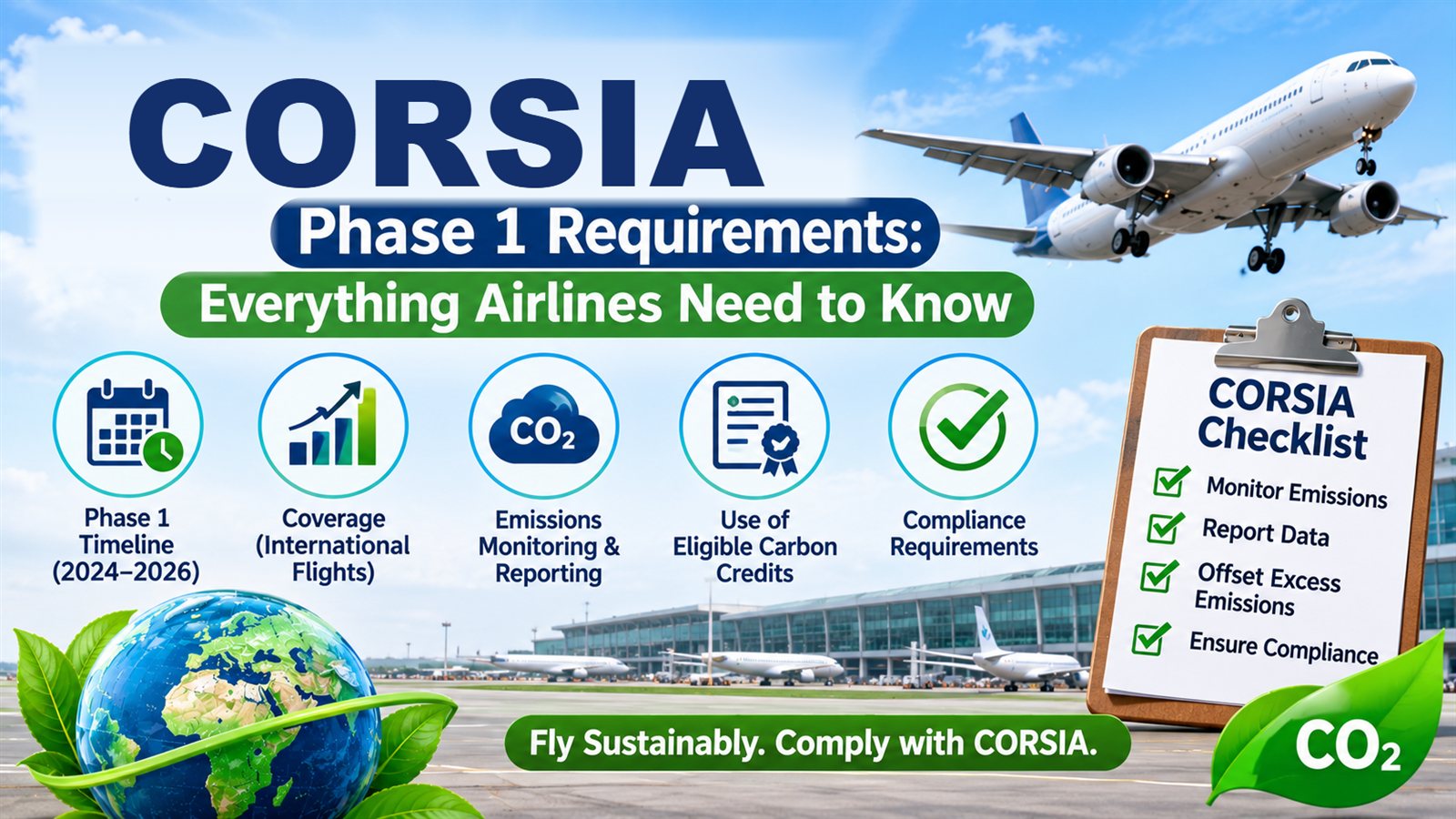
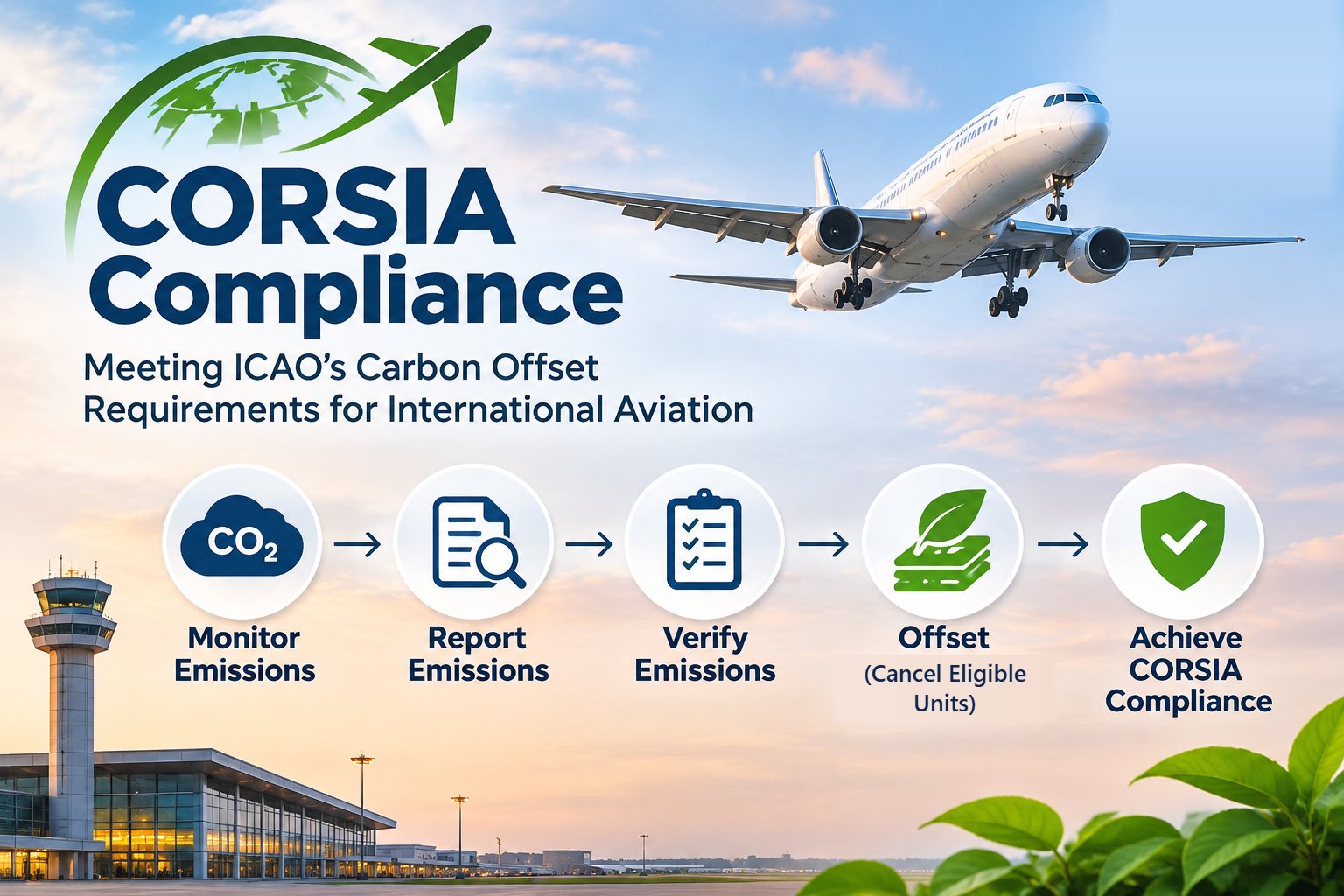
What are the CORSIA Phase 1 requirements? During CORSIA's First Phase, from 2024 to 2026, covered airlines must monitor their CO₂ emissions from international flights, report them each year to their administering State, have the reports independently verified, and cancel CORSIA eligible emissions units to cover their offsetting requirements on routes between participating States. Units for the whole 2024–2026 period must be cancelled by 31 January 2028. This guide from CORSIA Carbon Credits explains each requirement and how airlines can meet it.
Information in this guide was checked on 27 November 2026. Rules are set by ICAO's Annex 16, Volume IV, and applied through national law, so always confirm the details with your administering State.
Units for Phase 1 must be bought before they can be cancelled. Our guide to CORSIA carbon credit prices explains what eligible units cost in 2026.
Introduction to CORSIA Phase 1
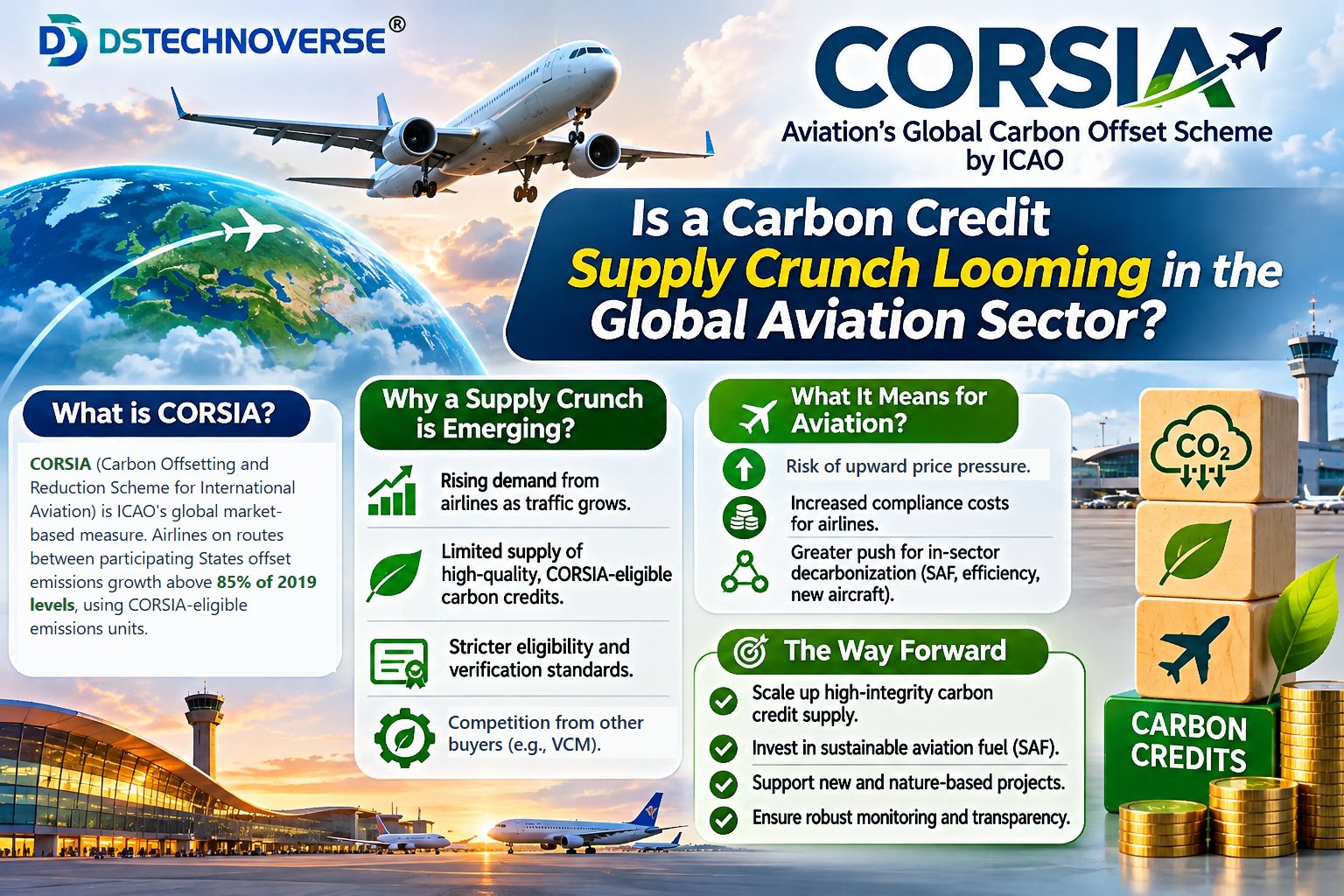
CORSIA stands for the Carbon Offsetting and Reduction Scheme for International Aviation. ICAO adopted it in 2016 to address growth in CO₂ emissions from international flights, which fall outside countries' national climate targets under the Paris Agreement. Airlines meet CORSIA by cutting emissions where they can, using eligible fuels, and offsetting the remaining growth with eligible carbon credits.
The First Phase matters because:
- it is the first CORSIA period using the tighter baseline of 85% of 2019 emissions
- it is the first period in which airlines need large volumes of eligible units, and supply is short
- it runs for three years, 2024 to 2026, with one final cancellation deadline at the end
- it prepares airlines for the mandatory Second Phase, which starts on 1 January 2027
Airlines that understand the requirements early can plan monitoring, budgets and credit purchases without last-minute pressure.
What Is CORSIA Phase 1?
CORSIA is being introduced in stages:
- Monitoring, reporting and verification (MRV): has applied since 1 January 2019 to all operators above the thresholds, whether or not they have offsetting requirements.
- Pilot Phase (2021–2023): the first offsetting period, with voluntary State participation.
- First Phase (2024–2026): the second offsetting period, also with voluntary State participation.
- Second Phase (2027–2035): all ICAO Member States participate, except those that are exempt and do not volunteer.
Voluntary for States, mandatory for operators
Participation in the First Phase is voluntary for States. ICAO listed 126 participating States in 2024 and 130 in 2026. Once two States both participate, however, the offsetting requirements for flights between them are mandatory for the covered operators flying those routes. An airline cannot opt out because its own State volunteered rather than being required to join.
Which Airlines Are Subject to CORSIA Phase 1 Requirements?
Operators above the thresholds
CORSIA applies to aeroplane operators that:
- emit more than 10,000 tonnes of CO₂ a year from international flights
- using aeroplanes with a maximum take-off mass above 5,700 kg
Route-based offsetting
Offsetting applies route by route. A flight creates an offsetting requirement only if it links two States that both participate in that year. ICAO publishes the list of State pairs subject to offsetting each year. For example, a flight between two participating States counts, but a flight from a participating State to a non-participating State does not create an offsetting requirement.
Attribution to an administering State
Each operator is attributed to one administering State, usually the State that issued its air operator certificate (AOC). That State approves its monitoring plan, receives its reports, calculates its offsetting requirement and oversees compliance. In India, CORSIA is administered by the Directorate General of Civil Aviation (DGCA).
Exemptions and special circumstances
- Humanitarian, medical and firefighting flights are excluded.
- State flights, such as military, customs and police flights, are outside the scheme.
- New entrants are exempt from offsetting for up to three years, subject to a size limit set in the rules.
- Domestic flights are outside CORSIA, because domestic emissions are covered by national climate targets.
Monitoring is not the same as offsetting
This is the most common misunderstanding. An operator above the thresholds must monitor and report emissions from all its international flights, even if none of them link two participating States. It may therefore have MRV obligations but no offsetting requirement. Our guide to CORSIA requirements explains these general obligations in more detail.
Key CORSIA Phase 1 Requirements for Airlines
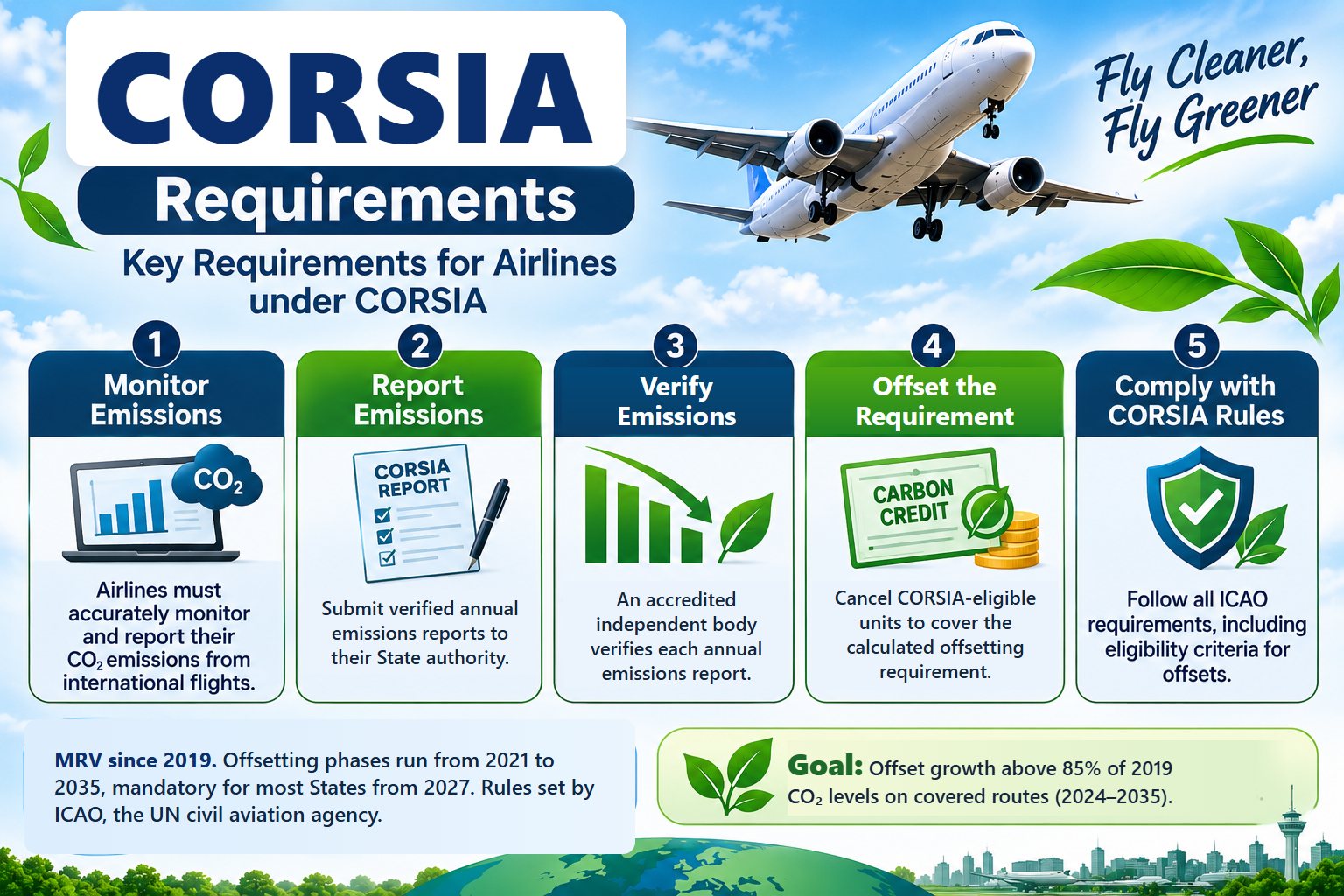
1. Emissions Monitoring
Airlines must monitor fuel use and CO₂ emissions from every international flight in scope.
- Emissions Monitoring Plan: each operator submits a plan to its State for approval, describing its fleet, flights, data flows and monitoring method. The plan must be updated when significant changes occur.
- Fuel use monitoring methods: ICAO's rules list five approved methods: Method A, Method B, Block-off/Block-on, Fuel Uplift, and Fuel Allocation with Block Hour.
- Fuel records: operators keep records of fuel uplifted, fuel in tanks and flight data, so emissions can be checked.
- CO₂ conversion factors: fuel burned is converted to CO₂ using fixed factors: 3.16 tonnes of CO₂ per tonne of Jet-A or Jet-A1, and 3.10 per tonne of Jet-B or AvGas.
- ICAO CORSIA CERT: smaller emitters can use ICAO's CO₂ Estimation and Reporting Tool instead of fuel monitoring, within thresholds set in the rules. Under current rules, operators below 500,000 tonnes of international CO₂ a year may use CERT, while larger operators must use a fuel use method for flights subject to offsetting.
2. Emissions Reporting
- Annual Emissions Report: operators report emissions for each calendar year using ICAO's standard template.
- Content: the report shows emissions by State pair, the fuel used, the monitoring method and any claims for CORSIA eligible fuels.
- Submission: the verified report goes to the administering State, generally by 30 April of the following year. States may set earlier internal deadlines.
- Supporting information: operators keep the data behind the report, such as fuel records and flight lists, for verification and State review.
3. Independent Verification
- Accredited verifiers: a third-party verification body accredited under ICAO's rules, usually through a national accreditation body, checks each annual Emissions Report.
- What they check: that the data is accurate, complete and consistent with the approved monitoring plan, and that material errors are corrected.
- Verification report: the verifier issues a verification report with its opinion, submitted with the Emissions Report.
- State checks: the administering State then reviews the report, including an order of magnitude check, before sending the data to ICAO.
4. Calculation of Offset Requirements
Airlines do not offset all their emissions. They offset their share of the sector's growth above the baseline.
- Baseline: 85% of the sector's 2019 international CO₂ emissions.
- Sector's Growth Factor: published by ICAO for each year. It shows by how much the whole sector exceeded the baseline, as a share of that year's emissions.
- Operator emissions: the operator's verified emissions on routes subject to offsetting.
- Calculation: the State multiplies the operator's covered emissions by the Sector's Growth Factor, for each year of the period.
- Eligible fuels: reductions from CORSIA eligible fuels, such as sustainable aviation fuel, can be deducted from the total.
The result, the offsetting requirement, is usually a small fraction of the airline's total emissions.
5. Cancellation of Eligible Emissions Units
- Eligible emissions units are carbon credits that meet ICAO's conditions for the First Phase.
- Voluntary credits are not automatically eligible. They must meet every CORSIA condition.
- Units must come from an ICAO-approved programme and fall within its approved scope.
- Vintage and other conditions apply, as explained below.
- Units must be cancelled in the programme's registry for CORSIA purposes, naming the operator and compliance period.
- The operator submits an Emissions Unit Cancellation Report to its State, which checks it and passes the information to ICAO.
CORSIA Phase 1 Baseline and Offset Calculation
The 2019 reference year and 85% baseline
From 2024, the CORSIA baseline is 85% of international aviation's 2019 CO₂ emissions. ICAO's 41st Assembly agreed this in 2022, after COVID-19 made 2020 emissions unrepresentative.
In the Pilot Phase (2021–2023), the baseline was 100% of 2019 emissions. Lowering it to 85% means more of the sector's emissions count as growth, so offsetting requirements are larger in the First Phase.
Sector-wide requirement
The sector's total offsetting need for a year is its emissions above the baseline. The Sector's Growth Factor turns that into a percentage:
Sector's Growth Factor = (sector emissions in the year − baseline) ÷ sector emissions in the year
In the First Phase, each operator's requirement is calculated using 100% of this sectoral factor. Individual growth factors only start to apply from 2033.
How an individual operator's requirement is calculated
Operator's annual requirement = operator's emissions on offsetting routes × Sector's Growth Factor
The three annual figures are added up for the 2024–2026 period, and eligible fuel reductions are deducted.
Illustrative example (hypothetical)
All values below are hypothetical. They are not ICAO figures or a real airline's calculation.
- An airline's verified emissions on offsetting routes are 400,000 tonnes in 2024, 420,000 tonnes in 2025 and 440,000 tonnes in 2026.
- Assume Sector's Growth Factors of 0.10, 0.12 and 0.13 for those years.
- Annual requirements: 40,000 + 50,400 + 57,200 = 147,600 tonnes.
- If the airline claims 2,600 tonnes of reductions from eligible fuels, it must cancel 145,000 eligible units for the First Phase.
The real growth factors are published by ICAO, and the administering State calculates the official figure.
CORSIA Phase 1 Compliance Timeline and Important Deadlines
Every year (2024, 2025 and 2026)
- 1 January to 31 December: monitor emissions according to the approved plan.
- Early in the following year: prepare the Emissions Report and have it verified.
- By 30 April of the following year: submit the verified report to the administering State.
- Later that year: the State checks the data and sends it to ICAO, and ICAO publishes the Sector's Growth Factor.
- By 30 November of the following year: the State informs the operator of its offsetting requirement for that year.
The three-year compliance period
- 2024–2026: the compliance period. Airlines can buy and cancel units at any time during or after it.
- By 30 November 2027: the State informs each operator of its total final offsetting requirement for 2024–2026.
- By 31 January 2028: the operator cancels enough eligible units and submits its Emissions Unit Cancellation Report.
Milestones in 2026 (as of 27 November 2026)
- 30 April 2026: verified Emissions Reports for 2025 were generally due.
- 30 November 2026: States are due to inform operators of their 2025 offsetting requirement.
- 31 December 2026: the last year of monitoring for the First Phase ends.
- Ongoing: ICAO's Technical Advisory Body made recommendations in September 2026, and the Council is expected to consider further eligible unit decisions.
Our CORSIA compliance calendar shows how the annual and period dates fit together. Check ICAO's latest implementation calendar and your State's dates before relying on them.
CORSIA Eligible Emissions Units for Phase 1
What makes a unit eligible
For the First Phase, a unit must:
- come from a programme approved by the ICAO Council
- fall within that programme's approved scope, with no excluded methodologies
- have a vintage from 2021 to 2026
- come from an activity that started on or after 1 January 2016
- have a Letter of Authorisation from the host country and a corresponding adjustment, or an approved compensation arrangement such as insurance
- carry the programme's First Phase label in the registry
ICAO's role and the Technical Advisory Body
The Technical Advisory Body (TAB) assesses programmes against ICAO's Emissions Unit Eligibility Criteria and recommends which to approve and on what terms. The ICAO Council makes the final decision.
Approved programmes
ICAO's April 2026 document lists ten programmes approved for the First Phase:
- American Carbon Registry (ACR)
- Architecture for REDD+ Transactions (ART)
- BioCarbon Fund Initiative for Sustainable Forest Landscapes (ISFL)
- Climate Action Reserve (CAR)
- Forest Carbon Partnership Facility (FCPF)
- Global Carbon Council (GCC)
- Gold Standard
- Isometric
- Premium T-VER (Thailand)
- Verra's Verified Carbon Standard (VCS)
The Paris Agreement Crediting Mechanism has conditional approval.
Programme approval is not unit approval
Not every credit from an approved programme is eligible. Some methodologies are excluded. For example, Verra methodologies VMR0006 and AMS-II.G are excluded for the First Phase. Units must also meet the vintage, authorisation and labelling conditions.
Our guide to CORSIA eligible emissions units explains the programmes and conditions in more detail.
Difference Between CORSIA Pilot Phase and First Phase
- Implementation period: the Pilot Phase ran from 2021 to 2023; the First Phase runs from 2024 to 2026.
- State participation: voluntary in both phases. The number of participating States has grown, from 126 in 2024 to 130 in 2026.
- Baseline: 100% of 2019 emissions in the Pilot Phase; 85% of 2019 emissions in the First Phase.
- Operator emissions used in the calculation: in the Pilot Phase, each State could choose to calculate its operators' requirements using either the current year's emissions or their 2020 emissions. In the First Phase, only the operator's current-year emissions are used.
- Offsetting requirements: because emissions in 2021–2023 stayed close to or below the 2019 baseline, Pilot Phase requirements were zero. First Phase requirements are expected to be substantial.
- Eligible units: Pilot Phase units needed vintages from 2016 to 2020, with no authorisation requirement. First Phase units need vintages from 2021 to 2026, plus a Letter of Authorisation and a corresponding adjustment.
- Compliance cycle: the Pilot Phase deadline was 31 January 2025; the First Phase deadline is 31 January 2028.
What Happens If an Airline Does Not Meet CORSIA Phase 1 Requirements?
ICAO's Annex 16, Volume IV sets the CORSIA rules, but it does not set penalties. Each State enforces CORSIA through its own national law, so consequences differ between States.
Common problems and what usually follows:
- Incorrect monitoring: the State may require corrections to the monitoring plan or the data.
- Late or incomplete reporting: if no verified report is submitted, the State can estimate the operator's emissions using available information, such as ICAO's CERT, which may overstate them.
- Verification problems: the verifier may refuse a positive opinion until errors are corrected.
- Not cancelling enough units: the operator fails to meet its offsetting requirement, and the State can take action under its national law.
- Corrective action: States generally ask operators to correct errors and resubmit reports.
- State oversight: sanctions can include fines or other administrative measures, depending on national law.
Check your administering State's CORSIA regulations to understand the actual consequences.
How Airlines Can Prepare for CORSIA Phase 1 Compliance
- Confirm your administering State and its CORSIA contact.
- Review your covered international routes against ICAO's State pairs list for each year.
- Understand your monitoring obligations, which apply to all international flights in scope.
- Keep accurate fuel records for every flight.
- Prepare and update your Emissions Monitoring Plan when your fleet or operations change.
- Use an appropriate monitoring method, or CERT where allowed.
- Appoint an accredited verification body early in the year.
- Submit annual Emissions Reports on time.
- Review your State's offsetting notifications each year.
- Source eligible emissions units where required, checking each unit's eligibility.
- Cancel units and keep documentation, including registry records and the cancellation report.
If you need units, our guide on how to buy CORSIA eligible carbon credits walks through the buying process step by step.
Common CORSIA Phase 1 Compliance Mistakes
- Confusing monitoring with offsetting: MRV applies even when no offsetting is required.
- Assuming every international flight is covered: only routes between two participating States create an offsetting requirement.
- Using incorrect emissions data: errors in fuel records or flight attribution flow through to the requirement.
- Missing reporting deadlines: late reports can lead to State estimates and enforcement action.
- Choosing an unsuitable monitoring method: larger operators cannot use CERT for flights subject to offsetting.
- Skipping independent verification: unverified reports do not meet the requirements.
- Buying ineligible carbon credits: voluntary credits and units from excluded methodologies cannot be used.
- Ignoring vintage restrictions: only 2021–2026 vintages count for the First Phase.
- Confusing purchased units with cancelled units: units in an account do not meet the requirement until they are cancelled for CORSIA.
CORSIA Phase 1 vs Second Phase: What Changes in 2027?
- Participation: in the First Phase, State participation is voluntary. From 2027, all ICAO Member States participate except those that are exempt and do not volunteer.
- Exemptions: least developed countries, small island developing States and landlocked developing countries are exempt, as are States with a very small share of international aviation activity (below 0.5% of revenue tonne kilometres) that are not among the States making up 90% of total activity.
- Route coverage: more routes will be subject to offsetting as more States participate. ICAO lists 134 States for 2027. Routes to and from exempt States are not subject to offsetting unless those States volunteer.
- MRV continues: monitoring, reporting and verification continue unchanged for all operators above the thresholds.
- Growth factor: fully sectoral until 2032, then 85% sectoral and 15% individual from 2033 to 2035.
- Eligible units: the first compliance period of the Second Phase runs from 2027 to 2029, with its own approved programmes and conditions. Fewer programmes had been approved for it as of September 2026.
For airlines in India, offsetting obligations are expected to start in 2027.
Frequently Asked Questions
What is CORSIA Phase 1?
It is CORSIA's First Phase, the second offsetting period of the scheme, covering 2024 to 2026. Participation is voluntary for States, but covered operators must offset emissions growth on routes between participating States.
What years does the CORSIA First Phase cover?
The First Phase covers 1 January 2024 to 31 December 2026, as one three-year compliance period. Units for it must be cancelled by 31 January 2028.
Which airlines must comply with CORSIA Phase 1?
Aeroplane operators emitting more than 10,000 tonnes of CO₂ a year from international flights with aeroplanes above 5,700 kg must monitor and report. Offsetting applies to their flights between two participating States, with exemptions for humanitarian, medical and firefighting flights and new entrants.
What are the main CORSIA Phase 1 requirements?
Monitoring emissions under an approved plan, reporting them each year, independent verification, calculation of the offsetting requirement by the State, and cancellation of eligible emissions units with a cancellation report.
Is CORSIA Phase 1 mandatory for airlines?
State participation is voluntary, but once two States both participate, offsetting is mandatory for covered operators on routes between them. MRV is mandatory for all operators above the thresholds.
What is the CORSIA baseline for 2024–2026?
The baseline is 85% of international aviation's 2019 CO₂ emissions. The Pilot Phase used 100% of 2019 emissions.
How are airline offsetting requirements calculated?
The State multiplies the operator's emissions on offsetting routes in each year by ICAO's Sector's Growth Factor, adds the three years together and deducts reductions from CORSIA eligible fuels.
Which carbon credits are eligible under CORSIA Phase 1?
Units from the ten programmes approved by ICAO, within their approved scope, with 2021–2026 vintages, activities starting on or after 1 January 2016, host-country authorisation with a corresponding adjustment, and a First Phase label.
What are the reporting and verification requirements?
Operators submit an annual Emissions Report, verified by an accredited third party, to their administering State, generally by 30 April of the following year. The State then reviews it and sends the data to ICAO.
What happens after CORSIA Phase 1 ends in 2026?
The mandatory Second Phase starts on 1 January 2027, with more participating States. Airlines receive their final First Phase requirement by 30 November 2027 and must cancel units by 31 January 2028.
Key Takeaways
- CORSIA's First Phase runs from 2024 to 2026 as one compliance period.
- MRV applies to all operators above the thresholds. Offsetting applies only to routes between participating States.
- The baseline is 85% of 2019 emissions, and requirements are calculated using the Sector's Growth Factor.
- Only units that meet every First Phase condition can be cancelled.
- Final requirements arrive by 30 November 2027, and units must be cancelled by 31 January 2028.
- National law, not ICAO, sets the penalties for non-compliance.
For more guides on CORSIA compliance and eligible units, explore the resources at CORSIA Carbon Credits.