 DSTechnoverse company
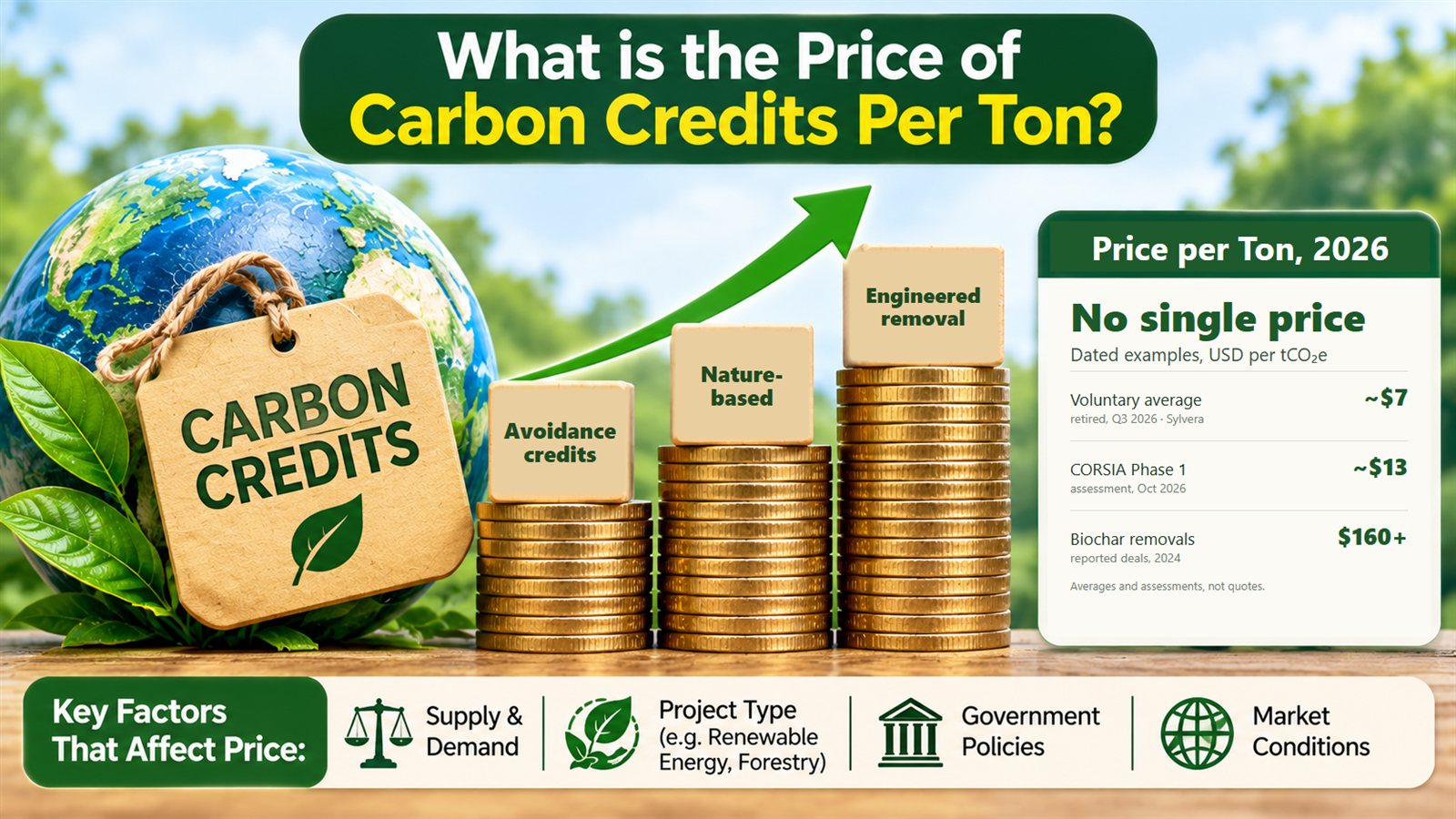
What is the price of carbon credits per ton? There is no single price. In 2026:
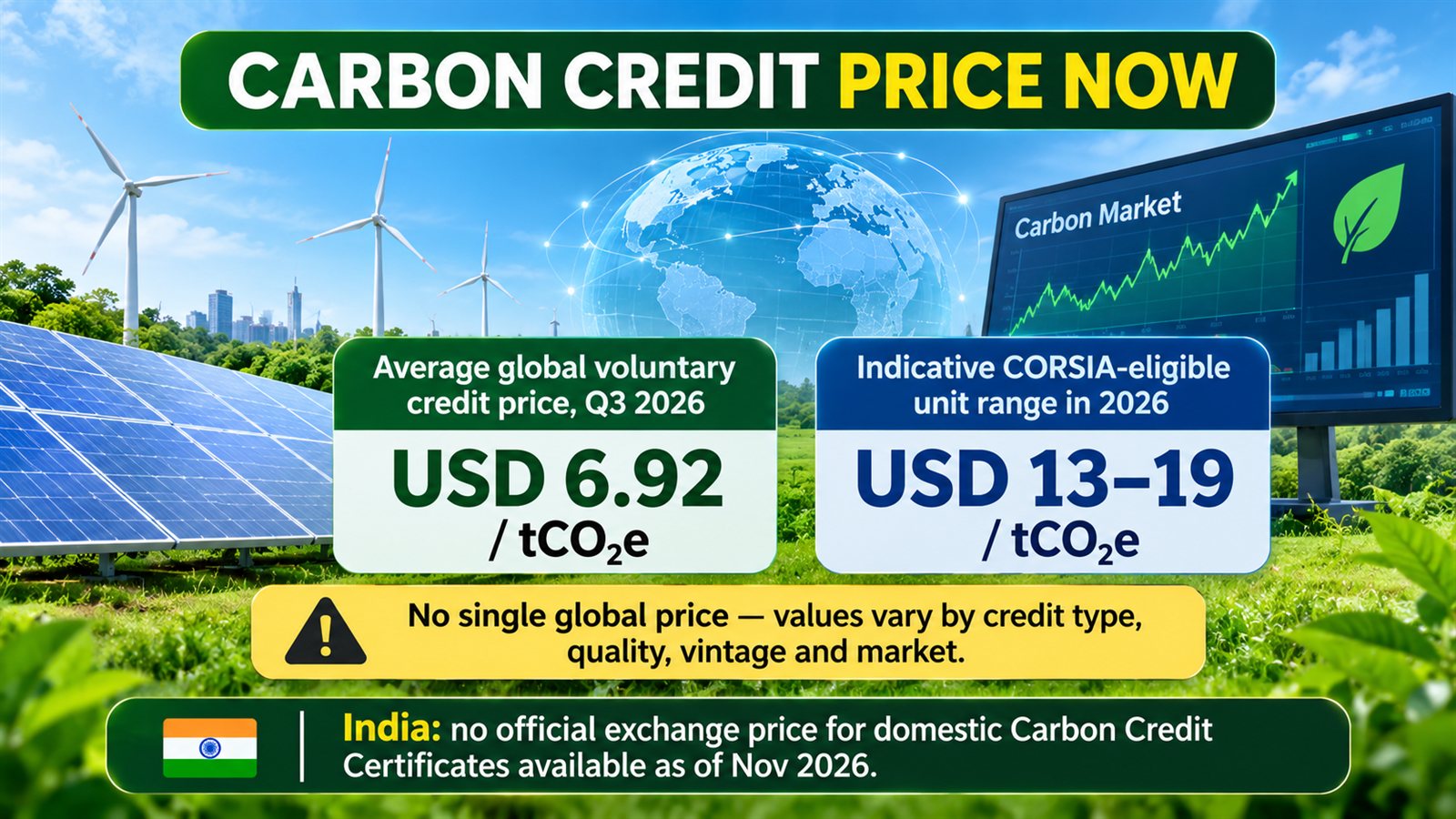
- the average voluntary carbon credit retired in Q3 2026 sold for about USD 6.92 per tonne of CO₂e, according to Sylvera data
- CORSIA-eligible units for international aviation were assessed at roughly USD 13–19 per tonne
- some engineered carbon removals, such as biochar, have sold for over USD 160 per tonne
What you pay depends on project type, quality, vintage, eligibility and market conditions. For aviation-specific pricing, see our CORSIA Carbon Credits resources.
This guide explains each price driver, gives dated figures and shows how to estimate a purchase budget. All figures reflect sources available in November 2026.
What Is a Carbon Credit and What Does One Ton Represent?
A carbon credit is a certificate issued by a crediting programme. It generally represents one metric tonne of carbon dioxide equivalent (tCO₂e) that a project has reduced, avoided or removed, under the issuing programme's rules. CO₂e converts other gases, such as methane, into the amount of CO₂ with the same warming effect.
A carbon offset is the use of a credit. When a buyer retires a credit against its own emissions, the credit becomes an offset. Our explainer on the difference between carbon credits and carbon offsets covers this in detail.
Quality and verification matter because a credit is only worth paying for if the tonne behind it is real. That means the project must:
- be additional, meaning it would not have happened anyway
- be measured against a realistic baseline
- be independently verified
- be tracked in a registry so the credit is used only once
What Is the Average Price of Carbon Credits Per Ton?
Prices differ sharply between voluntary markets, where companies buy credits by choice, and compliance markets, where laws create demand. Within each market, prices also differ by project type and quality.
| Market segment | Price (USD per tCO₂e unless stated) | Date | Type of figure | Source |
|---|---|---|---|---|
| Voluntary credits, all types | about 6.92 | Q3 2026 | Average of credits retired | Sylvera, via price tracker |
| Voluntary credits, all types | about 6.12 | Q1–Q3 2026 | Average of credits retired | Sylvera |
| Reduction (avoidance) credits | about 4.05 | 2024 | Average of reported deals | Ecosystem Marketplace |
| Removal credits | about 19.50 | 2024 | Average of reported deals | Ecosystem Marketplace |
| CORSIA first-phase units (spot) | 19.00 | 28 Jan 2026 | Price assessment | Fastmarkets |
| CORSIA first-phase units (Dec 2026 delivery) | 13.15 | Mid-Oct 2026 | Price assessment | green.earth |
| EU ETS allowances (compliance permits) | about €90 | 2–4 Nov 2026 | Exchange futures price | GMK Center |
The figures are of different types:
- An average summarises many past deals.
- An assessment is a price reporting agency's estimate of the market.
- A quote is what a seller is asking.
- A transaction price is what was actually paid.
None of the figures above is a quote for a specific credit.
EU ETS allowances are permits to emit under a cap, not carbon credits. Voluntary credits cannot be used in their place, so the two prices are not directly comparable.
What Factors Affect the Price of Carbon Credits?
- Project type. Reductions, such as renewable energy, usually cost less than removals, such as biochar or direct air capture.
- Environmental integrity and additionality. Credits with strong evidence that the project needed carbon finance tend to command more.
- Verification and certification standards. The programme and methodology version affect buyer confidence.
- Permanence and reversal risk. Durable storage is valued more highly. Forestry credits carry fire and logging risk, which buffer pools help manage.
- Vintage and location. Newer vintages are often preferred, and some buyers or rules favour certain regions or require host-country authorisation.
- Co-benefits. Projects with biodiversity, health or community benefits can earn a premium.
- Supply and demand. Limited supply of a credit type, or rising demand for it, pushes prices up.
- Regulations and buyer requirements. Eligibility for compliance schemes such as CORSIA narrows supply and raises value.
How Do Carbon Credit Prices Differ by Project Type?
| Project type | What it does | Reported figure | Why the price differs |
|---|---|---|---|
| Renewable energy | Avoids fossil electricity | about USD 2.67 (2024, Ecosystem Marketplace) | Additionality often questioned where renewables are already cheap, and supply is large |
| Forest protection (REDD+) | Avoids deforestation | USD 3.56–7.75 by rating (Q3 2026, Sylvera) | Wide quality range and baseline concerns |
| Reforestation and afforestation (ARR) | Removes CO₂ as trees grow | USD 12.80–23.47 by rating (Q3 2026, Sylvera) | Removals, co-benefits, long timelines |
| Methane capture | Destroys landfill or farm methane | Varies | Large measurable reductions, but additionality depends on local rules |
| Clean cooking | Cuts fuel use and smoke | about USD 7.30 for household devices (2024, Ecosystem Marketplace) | Health co-benefits, measurement challenges |
| Soil carbon and agriculture | Stores carbon in soils | Varies | Measurement uncertainty and permanence risk |
| Biochar and engineered removals | Durable carbon storage | over USD 160 for biochar (2024, Ecosystem Marketplace) | High costs, high durability, limited supply |
These figures are averages or reported ranges, not fixed prices. Individual deals for each type vary widely.
Voluntary Carbon Market vs Compliance Carbon Market Pricing
- Voluntary carbon market: companies buy credits from programmes such as Verra or Gold Standard for their own climate goals. Prices depend on project type, quality ratings and how many companies are buying.
- Compliance carbon markets: governments or international bodies require regulated entities to hold allowances or eligible units. Legal obligations create steady demand, and supply is set by the scheme. In the EU ETS, for example, that has kept allowance prices far above average voluntary credit prices.
Prices across markets cannot be compared directly, because the instruments, rules and uses differ. A voluntary credit is not automatically eligible for any compliance scheme.
What Is the Price of CORSIA Carbon Credits Per Ton?
CORSIA, the Carbon Offsetting and Reduction Scheme for International Aviation, is ICAO's global market-based measure for international aviation's CO₂. Airlines with offsetting requirements on routes between participating States must cancel CORSIA eligible emissions units.
There is no official CORSIA price. ICAO decides which units are eligible, but it does not sell credits or run an exchange. Published assessments for first-phase (2024–2026) units fell from USD 19.00 per tonne on 28 January 2026 (Fastmarkets spot assessment) to USD 13.15 per tonne for December 2026 delivery (cited in mid-October 2026). The fall followed more labelled units reaching the market.
What affects the price of a CORSIA unit:
- whether the programme is approved for the relevant compliance period
- whether the unit meets the conditions: for the first phase, activities starting on or after 1 January 2016, vintages from 2021 to 2026, host-country authorisation and a corresponding adjustment, and a CORSIA label
- the balance between limited eligible supply and airline demand
Ordinary voluntary credits are not automatically CORSIA eligible. Our guide to the CORSIA carbon credit price in 2026 covers these figures in more depth.
How Can Businesses Estimate the Cost of Buying Carbon Credits?
Total estimated cost = Number of carbon credits × Price per credit
Then add brokerage, registry and due diligence costs.
Example 1: Voluntary climate commitment (hypothetical)
All figures are illustrative assumptions, not market quotes. A company wants to offset 1,000 tonnes of residual emissions and assumes USD 10 per credit:
1,000 × USD 10 = USD 10,000, before fees.
Example 2: Comparing nature-based and engineered removals (hypothetical)
Illustrative assumptions only. An organisation wants 500 tonnes of removals and compares:
- Reforestation credits assumed at USD 20: 500 × 20 = USD 10,000
- Biochar credits assumed at USD 150: 500 × 150 = USD 75,000
The higher cost buys more durable storage, but the organisation also weighs co-benefits and its budget.
Example 3: An airline under CORSIA (hypothetical)
Illustrative assumptions only. An airline's State confirms an offsetting requirement of 20,000 tonnes for the compliance period. The airline assumes USD 15 per eligible unit:
20,000 × USD 15 = USD 300,000, before fees.
It must also confirm that each unit is eligible and cancel the units for CORSIA. Our article on CORSIA eligible carbon credits explains the eligibility checks.
How to Evaluate Whether a Carbon Credit Is Worth Its Price
- Project documentation: read the design document and monitoring reports.
- Independent validation and verification: review the auditor's reports.
- Registry records: confirm that the serial numbers exist and the credits are active.
- Additionality and permanence: look at the evidence, and at buffer pools for nature-based credits.
- Double-counting safeguards: check that no one else can claim the same tonne.
- Retirement records: make sure you will receive proof that the credits were retired in your name.
- Host-country authorisation and corresponding adjustments, where your use requires them.
- CORSIA eligibility against ICAO's current document, if the credits are for aviation compliance.
The cheapest credit is not always the best value. A low-priced credit that fails these checks, or does not qualify for your purpose, can cost more in the end through reputational or compliance risk. A high price does not guarantee quality either.
How Could Carbon Credit Prices Change in the Future?
Possible influences include:
- climate regulations and policy, including rules on environmental claims and new compliance schemes
- corporate net-zero commitments, which affect voluntary demand
- aviation compliance demand, as CORSIA's second phase starts in 2027
- carbon removal technology, where costs may fall as projects scale
- quality standards and integrity initiatives, which are already widening the price gap between low- and high-rated credits
- supply and buyer preferences, such as new issuances, methodology changes and interest in removals
These are possibilities, not predictions. Carbon credit prices have moved substantially in both directions in recent years, and future prices cannot be forecast with certainty.
Frequently Asked Questions
What is the price of one carbon credit per ton?
There is no single price. Average voluntary credits retired in Q3 2026 sold for about USD 6.92 per tonne (Sylvera). CORSIA-eligible units were assessed at about USD 13–19 in 2026, and some engineered removals cost over USD 160.
How much does it cost to offset one ton of CO₂?
The cost of retiring one credit depends on the credit chosen. It can range from a few dollars for some avoidance credits to well over USD 100 for durable removals, plus any fees.
Why do carbon credit prices vary so much?
Credits differ in project type, integrity, permanence, vintage, co-benefits and eligibility, and they are sold in different markets with different supply and demand.
Are carbon credits more expensive in compliance markets?
Compliance instruments often cost more because laws create steady demand. EU ETS allowances were about €90 in November 2026. But allowances are not the same as voluntary credits, so prices are not directly comparable.
What is the price of CORSIA-eligible carbon credits?
There is no official price. Published assessments for first-phase units ranged from USD 19.00 per tonne (28 January 2026, Fastmarkets) to USD 13.15 per tonne for December 2026 delivery (mid-October 2026).
Does one carbon credit always represent one ton of CO₂?
Generally, one credit represents one metric tonne of CO₂ equivalent, which can include other greenhouse gases converted to CO₂ terms, under the issuing programme's rules.
How can businesses find reliable carbon credit prices?
Use dated data from price reporting agencies, market data providers, exchanges and verified supplier quotes for identified credits. Always compare the same category, date, currency and type of figure.
Key Takeaways
So, what is the price of carbon credits per ton? It depends on what you buy. In 2026:
- average voluntary credits sold for around USD 7
- CORSIA-eligible units were assessed at USD 13–19
- durable removals can cost over USD 160
Prices vary because credits differ in type, quality, permanence, vintage and eligibility, and because each market has its own supply and demand. Buyers should judge quality, verification, eligibility and environmental integrity, not just cost.
Our article on the value of carbon credits looks at their financial and environmental value in more depth. For CORSIA pricing and eligibility, explore the resources at CORSIA Carbon Credit.
Sources
- Carbon credit price tracker – Sylvera and Ecosystem Marketplace data (reviewed 5 October 2026)
- Fastmarkets – CORSIA spot prices continue to slide (4 February 2026)
- green.earth – CORSIA activity builds across prices, airlines and supply (16 October 2026)
- GMK Center – European carbon prices exceeded €90/t in November (1 November 2026)
- ICAO – CORSIA Eligible Emissions Units
- World Bank – Carbon Pricing Dashboard
- Verra
- Gold Standard